Pool Cages Built to Fit
Custom Pool Enclosures in Jacksonville, FL
A custom pool enclosure is designed around your pool's exact shape, deck layout, and roofline rather than a standard cage size.
Custom pool enclosures Jacksonville FL homeowners need start where standard kits stop: freeform curves, kidney shapes, attached spas, tanning ledges, and decks that wrap around landscaping. Unlike stock pool enclosures Jacksonville builders drop onto a rectangle, a custom structure is designed around your pool's actual footprint, with roof, wall panels, and door placement engineered to that shape. Most pool screen enclosures Jacksonville FL properties end up with are a compromise; Jacksonville pool enclosures built to the deck as it exists are not.
This is especially common in Jacksonville, where many pools were added to existing homes years after the original construction, on lots with grade changes, mature landscaping, or setback restrictions near marshes and waterways. This page covers what goes into designing and building a custom pool cage here, from layout considerations to mesh and screen roof options to the weather factors that matter most around a pool.
When a Pool Needs a Custom Enclosure
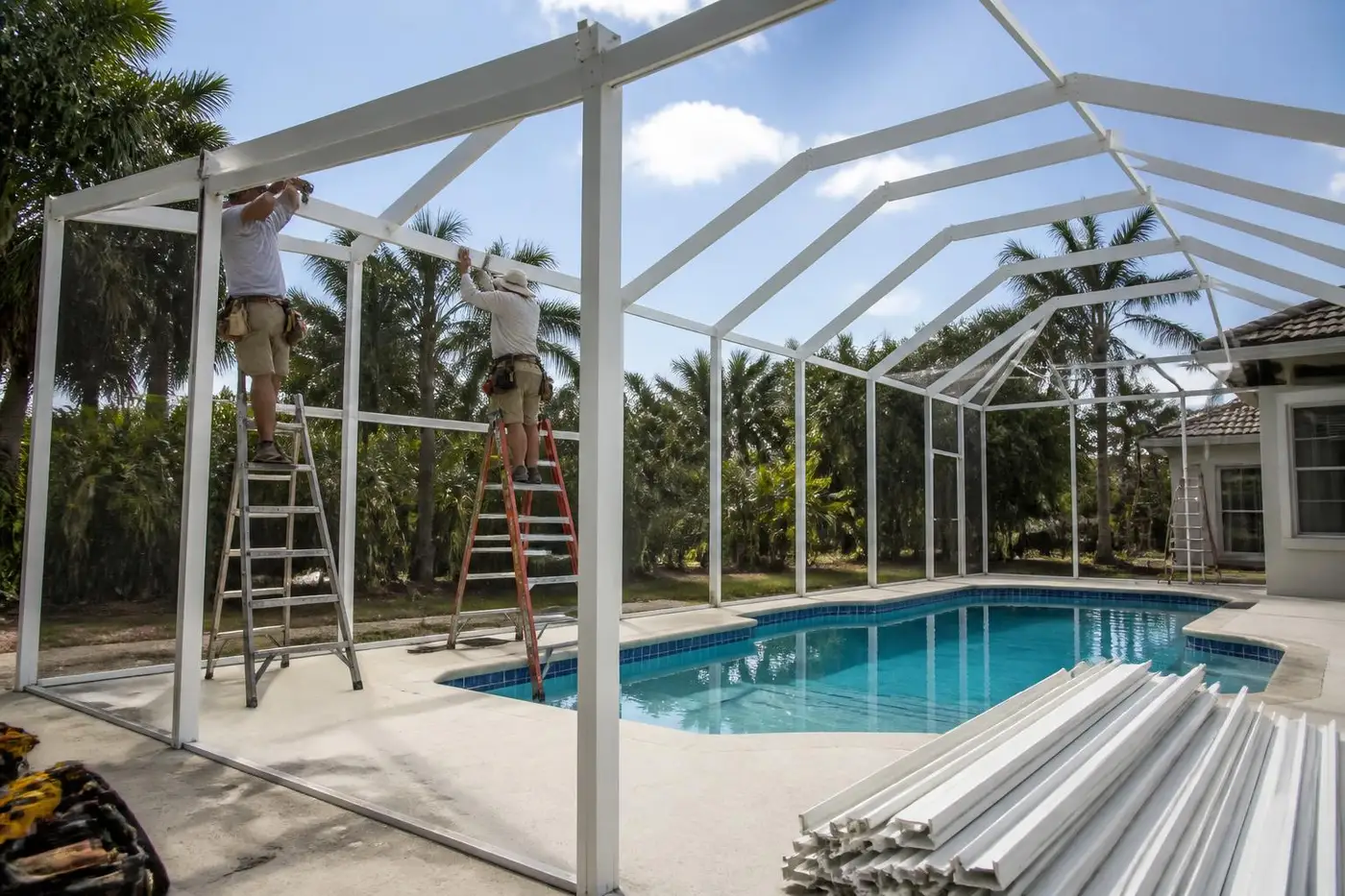
If your pool is freeform or kidney-shaped, includes an attached spa or tanning ledge, or sits on a deck with an irregular perimeter, a standard rectangular cage either won't fit the space efficiently or will leave awkward unused deck area. Sloped lots, mature trees close to the pool, and property line setbacks near waterfront lots also often push a design toward a custom layout rather than a standard configuration.
Why This Matters More in Jacksonville
Many Jacksonville pools were installed after the home was originally built, fitted into whatever backyard space was available rather than planned alongside the house. That history, combined with mature oak trees, grade changes near the river and marshes, and older neighborhoods with tighter lot lines, means a lot of local pool decks simply don't match a standard cage footprint.
Roof and Panel Design for Pool Cages
Pool cage roofs are typically either screened roof panels, which maximize sunlight and airflow over the pool, or a mix of solid panels over a portion of the deck (for shaded seating) with screened panels over the pool itself. On a custom cage, roof height and pitch are engineered to clear existing rooflines and to shed water properly at valleys or transitions created by an irregular shape.
Wall panels follow the pool deck's actual perimeter, which on a custom design might include angled sections, curved runs approximating a rounded deck edge, or stepped sections where the deck steps down toward the yard.
Screened roof panels
Maximize sunlight and airflow directly over the pool surface.
Mixed roof zones
Solid panels over seating areas paired with screened panels over the pool.
Curved and angled wall runs
Panels custom cut to follow a freeform pool deck's actual edge.
Mesh Choices for a Pool Setting
Standard 18/14 fiberglass mesh is common over pools since it balances visibility, airflow, and bug control. Solar or privacy mesh is a popular upgrade on south- and west-facing pool cage panels to cut glare off the water and reduce afternoon heat buildup on the deck. 20/20 no-see-um mesh is worth considering for pools near wooded or marsh-adjacent lots where smaller biting insects are more of a problem.
Repair, Rescreen, or Rebuild Around a Pool
Pool cages take more weathering than patio or porch enclosures because of constant sun exposure and pool chemical off-gassing, which can accelerate screen degradation and fastener corrosion over time. If the frame is still square and sound, a rescreen with fresh mesh and spline is usually the right move. If the frame shows corrosion at multiple joints, sagging roof panels, or was never engineered properly for its span in the first place, a custom rebuild addresses the underlying structural issue instead of just refreshing the screen.
Permitting and Engineering
Pool cages require a permit with engineered drawings confirming the structure meets Florida Building Code wind load requirements, and this engineering step is more involved on a custom shape than a standard rectangular cage because load paths across angled or curved roof sections need individual calculation. Expect a footer or anchor inspection and a final inspection once the structure and screen are complete.
Weather Factors Specific to Pool Enclosures
Pool cages face more direct, sustained sun exposure than most other enclosures, which accelerates UV breakdown of standard mesh over time - a reason some homeowners choose slightly heavier or UV-treated mesh over a pool. Wind load is also a bigger factor given the larger open roof spans typical of pool cages, particularly during hurricane season. Salt air near the coast and pool chemical exposure both argue for stainless steel fasteners over standard coated hardware, and heavy summer thunderstorms make proper drainage design at roof valleys essential to avoid pooling water on custom roof transitions.
Budget Planning for a Custom Pool Cage
Custom pool cages cost more than standard rectangular cages of the same square footage because of the additional engineering, custom panel cutting, and more complex permitting review. Roof type (solid, screened, or mixed), mesh upgrades, the number of angled or curved sections, and overall size are the main cost drivers. Because pool decks vary so much from house to house, an on-site measurement is the only reliable way to get an accurate number for your specific pool.
Keep Reading
Related services to compare
Build new: Custom Screen Enclosures
New pool cages, pool enclosures, lanais, screened patios, screen rooms, and custom aluminum structures.
Pool Screen Repair in Jacksonville
Targeted fixes for torn screen, damaged panels, doors, frames, hardware, and storm damage.
Repair option: Pool Cage Repair
Targeted fixes for torn screen, damaged panels, doors, frames, hardware, and storm damage.
Fix it first: Pool Enclosure Repair
Targeted fixes for torn screen, damaged panels, doors, frames, hardware, and storm damage.
Pool Cage Rescreening for worn screen
Fresh mesh across a panel, a wall, or an entire pool cage, with the screen type matched to how you use the space.
Full rebuild: Pool Cage Replacement
Full replacements and rebuilds when an aging or storm-damaged enclosure is past practical repair.
Local Coverage
Custom Pool Enclosures across the Jacksonville area
Custom Pool Enclosures in St. Johns
Custom Pool Enclosures in Fruit Cove
Custom Pool Enclosures in Julington Creek
Custom Pool Enclosures in Mandarin
Custom Pool Enclosures in Ponte Vedra Beach
Custom Pool Enclosures in Nocatee
Custom Pool Enclosures in Jacksonville Beach
Custom Pool Enclosures in Orange Park
Custom Pool Enclosures in St. Augustine
Custom Pool Enclosures in Atlantic Beach
Custom Pool Enclosures in Neptune Beach
Custom Pool Enclosures in World Golf Village
Custom Pool Enclosures in Green Cove Springs
Custom Pool Enclosures in Middleburg
Custom Pool Enclosures in Fleming Island
Custom Pool Enclosures in Rivertown
FAQ
Custom Pool Enclosures questions
Do freeform pools always need a custom enclosure?+
Usually yes, since freeform and kidney-shaped pools rarely align with a standard rectangular cage layout, and a custom design follows the pool's actual edges more efficiently.
What roof option is best directly over a pool?+
Screened roof panels are the most common choice over the pool itself to maximize sunlight and airflow, sometimes paired with solid panels over an adjacent seating area.
Does pool chemical exposure affect the enclosure?+
Yes, pool chemical off-gassing combined with constant sun exposure can accelerate mesh and fastener wear over time compared to a non-pool enclosure.
How long does a custom pool cage take to build?+
Timelines depend on the shape's complexity and permit review time, but expect longer design, engineering, and construction time than a standard rectangular cage.
Is a custom pool cage more expensive than a standard one?+
Generally yes, due to the additional engineering and custom panel fitting required for an irregular shape.
Call (904) 853-3510 for a free on-site estimate for your custom Jacksonville pool enclosure.
Request an estimate