Rescreening for any enclosure type
Screen Enclosure Rescreening Services in Jacksonville, FL
Rescreening service for lanais, patio enclosures, and pool cages across Northeast Florida.
Rescreening services Jacksonville homeowners look for cover more than pool cages — lanais, screened patios, porch enclosures, and carport screening all use aluminum framing that holds mesh instead of glass. Whatever the structure, the mesh and spline wear out long before the frame does, and screen enclosure rescreening Jacksonville properties need restores the whole enclosure without a rebuild. That includes rescreening pool enclosures, a full pool rescreen, lanai rescreening, and patio rescreening.
Jacksonville's mix of intense summer sun, heavy afternoon rain, coastal salt air near the beaches and Intracoastal, and an active hurricane season puts real stress on screen enclosures year after year. Homeowners often assume a torn or sagging enclosure means starting over, but in the vast majority of cases the aluminum frame is still sound and only the screen panels need replacing.
This page covers what rescreening involves across different enclosure types, how to know when it's time, what to expect from the process, and how enclosure rescreening gets priced in this market.
What Screen Enclosure Rescreening Means
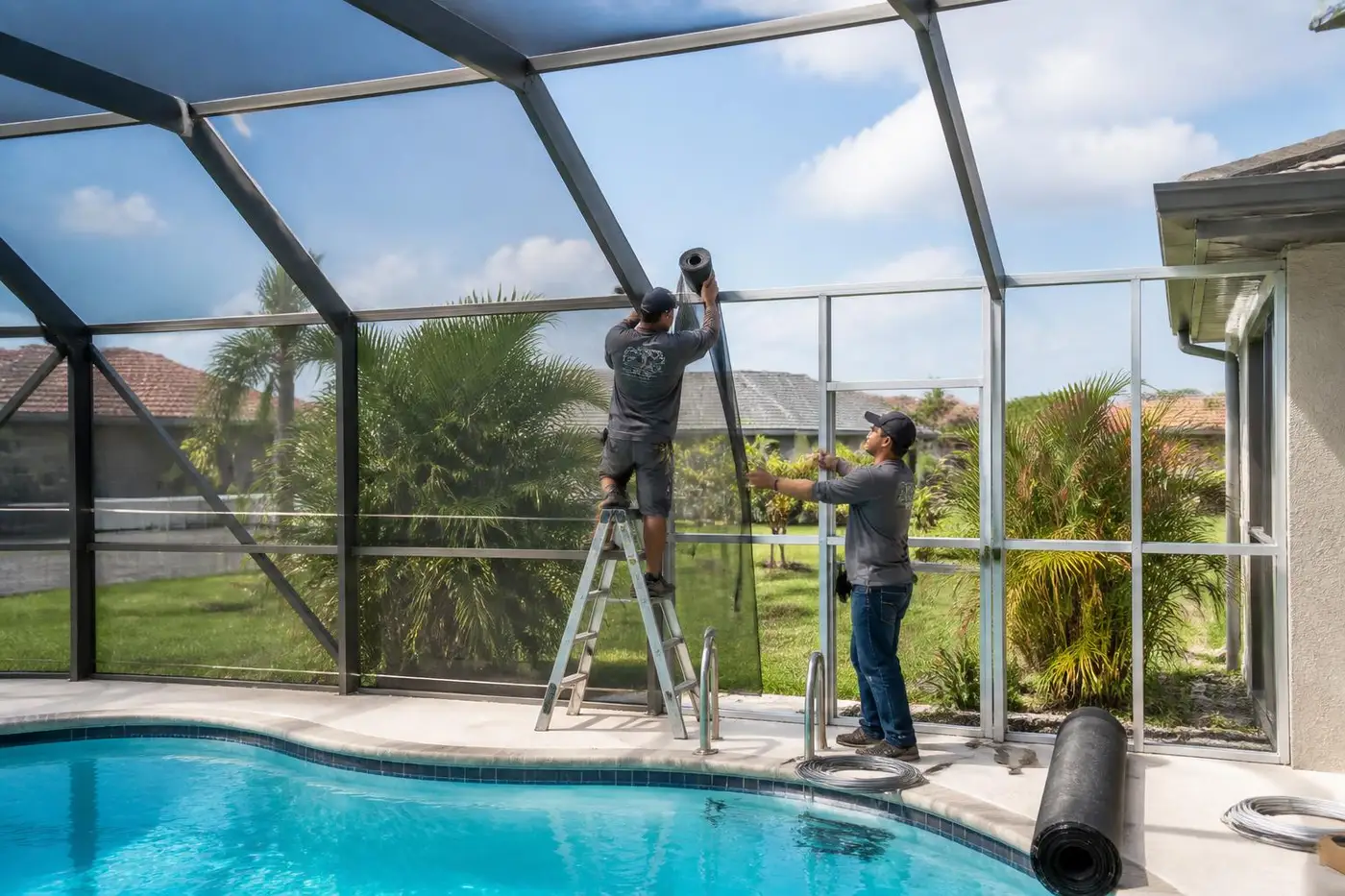
Rescreening is the process of removing worn mesh and spline from the aluminum channel that runs around each screen panel, then installing new mesh and spline in that same channel. It works on any framed screen structure - lanai, pool cage, porch enclosure, or carport - because the technique is the same regardless of what the enclosure is attached to or what it's used for.
The frame itself, the posts, beams, kickplates, and door hardware, stays in place. Rescreening doesn't address structural issues with the aluminum; it only replaces the screen panels that fill the spaces between the framing members. That's what keeps it faster and less expensive than a full enclosure rebuild.
Enclosures can be rescreened entirely at once or in sections, and it's common for homeowners to rescreen the most sun-exposed or storm-damaged side first and handle the rest in a later phase if budget or scheduling makes that practical.
Why Enclosures Around Jacksonville Wear Out
UV exposure is the single biggest factor. Fiberglass screen mesh is engineered to handle sunlight for years, but Jacksonville's subtropical sun angle and long summer days push mesh toward the end of its service life faster than in cooler climates. Screen facing south or west typically fails first because it gets the most direct afternoon sun.
Humidity and heavy pollen season add wear too - pollen builds up on mesh every spring and often gets pressure washed off, which is harder on screen than rain alone. Homeowners near the beaches or Intracoastal also deal with salt air, which doesn't degrade the mesh fibers directly but does corrode fasteners and spline over time, loosening panels even before the screen itself tears.
Storm season is the wildcard. A single strong afternoon thunderstorm can drive a branch or patio furniture through a screen panel, and named storms during hurricane season routinely damage multiple panels on the windward side of an enclosure at once.
Signs Your Enclosure Needs Rescreening
Some damage is obvious, like a hole from a fallen limb. Other signs build up gradually and are easy to overlook until they add up across the whole structure.
Multiple small tears or punctures
Several separate holes across different panels usually signal the mesh is at the end of its life, not just unlucky damage.
Screen pulling away from the frame
Gaps at the edge of a panel mean the spline has shrunk, dried out, or come loose from age.
Faded, brittle, or chalky mesh
Sun-damaged screen loses flexibility and snaps or crumbles instead of flexing under pressure.
Increased bugs or debris getting inside
If insects are getting into a lanai or patio despite no obvious hole, small deteriorated spots are often the cause.
Repair, Rescreen, or Replace: Making the Call
A single fresh tear in newer screen is a repair job - patch or replace that one panel. Once damage or deterioration shows up across multiple panels, or the mesh is uniformly old and brittle throughout the enclosure, a full rescreen typically makes more financial sense than fixing panels one at a time over repeated visits.
Full replacement of the enclosure - meaning new aluminum framing, not just new screen - only becomes necessary when the frame itself has structural problems: corroded or bent posts, footers pulling loose from the slab, or roof beams that have failed. In that case, rescreening alone won't solve the underlying issue, and the conversation shifts to whether repair of the frame or a full rebuild makes more sense for the property.
Mesh and Material Choices
Standard 18x14 fiberglass screen remains the default for most enclosures because it balances airflow, visibility, and cost well. For lanais and patios near wetlands or marsh grass where biting midges are common, 20x20 no-see-um mesh has a tighter weave that keeps those insects out, though it does reduce airflow slightly.
Pet screen is worth considering on lower panels of any enclosure where dogs regularly lean or scratch against the screen, since it's noticeably more puncture and tear resistant than standard mesh. Solar and privacy mesh options cut glare and add shade on patios and lanais that get intense afternoon sun, at the cost of reduced visibility through the panel.
18x14 fiberglass
Standard choice for most lanais, patios, and pool cages.
20x20 no-see-um mesh
Tighter weave for areas near marsh, wetlands, or standing water.
Pet screen
Heavier-duty mesh for lower panels exposed to pets.
Solar/privacy mesh
Reduces sun glare and adds privacy on patios and lanais.
How the Rescreening Process Works
The process is the same core technique across enclosure types, adjusted for panel size and access. Old spline and mesh are removed from the aluminum channel and the channel is cleaned so new spline seats correctly. New screen is cut with margin, positioned across the opening, and pressed into the channel with a spline roller working around the perimeter to keep the mesh even and taut. Excess mesh is trimmed with a utility knife once the spline is fully seated.
On lanais and patios with lower panel heights, most of this work happens from ground level or a short ladder. Pool cages and taller carport enclosures often require extended ladders or a lift for roof and upper wall panels. Door panels get extra attention since spline needs to be seated to allow smooth door operation without leaving gaps at the hinge or latch side.
Florida Weather Considerations
Scheduling around Jacksonville's weather patterns matters for a clean rescreen job. Afternoon thunderstorms are a near-daily occurrence for months at a time in summer, so morning starts are typical for larger jobs. Wind is a bigger concern on taller or roof-level panels, where large uncut sheets of mesh can catch gusts before they're secured.
Humidity affects handling too, since screen and spline both perform slightly differently in high moisture conditions than on a dry, mild day. For enclosures near the coast, ongoing salt exposure is worth discussing with the installer, since it affects how quickly fasteners and spline may need attention again down the road, even though the mesh itself isn't directly degraded by salt in the same way.
Planning for the Cost of Rescreening
Enclosure rescreening is typically priced by panel count or total mesh square footage, with larger and taller panels costing more due to material and labor time. Enclosures with roof panels, like pool cages, generally cost more per panel than single-story lanai or patio enclosures with only wall panels, because of the access equipment involved.
Mesh selection changes the price too - upgrading from standard 18x14 to no-see-um, pet screen, or privacy mesh adds cost per linear foot across the job. Door panels, curved or custom-shaped panels, and enclosures with a lot of small individual panels instead of large open sections also add labor time. An in-person walkthrough is the most accurate way to scope the job, since enclosure layouts vary widely across Jacksonville properties.
Rescreening Services by Enclosure Type
Different enclosures wear differently, so we scope each one on its own terms. Use the page that matches your structure for detail on materials, sequence, and what drives the number:
Pool cage rescreening
Full mesh replacement on a tall pool cage, including roof panels. See pool cage rescreening.
Pool enclosure rescreening
Lower-profile pool enclosures and screen rooms over a deck. See pool enclosure rescreening.
Patio rescreening
Screened patios and porches, panel by panel or all at once. See patio screen replacement.
Lanai screen work
Attached lanais that see daily use and door wear. See lanai screen repair.
No-see-um upgrades
Swap to a 20/20 weave while the mesh is already out. See no-see-um screen installation.
Screen mesh replacement
Choosing fiberglass, pet-resistant, or heavy-duty material. See screen mesh replacement.
Keep Reading
Related services to compare
Fresh mesh with Pool Enclosure Rescreening
Fresh mesh across a panel, a wall, or an entire pool cage, with the screen type matched to how you use the space.
Screen Enclosure Repair in Jacksonville
Targeted fixes for torn screen, damaged panels, doors, frames, hardware, and storm damage.
Repair option: Pool Enclosure Repair
Targeted fixes for torn screen, damaged panels, doors, frames, hardware, and storm damage.
Fix it first: Storm Damage Screen Enclosure Repair
Targeted fixes for torn screen, damaged panels, doors, frames, hardware, and storm damage.
Screen Enclosure Installation for Jacksonville homes
New pool cages, pool enclosures, lanais, screened patios, screen rooms, and custom aluminum structures.
Planning Pool Enclosure Installation
New pool cages, pool enclosures, lanais, screened patios, screen rooms, and custom aluminum structures.
Local Coverage
Screen Enclosure Rescreening across the Jacksonville area
Screen Enclosure Rescreening in St. Johns
Screen Enclosure Rescreening in Fruit Cove
Screen Enclosure Rescreening in Julington Creek
Screen Enclosure Rescreening in Mandarin
Screen Enclosure Rescreening in Ponte Vedra Beach
Screen Enclosure Rescreening in Nocatee
Screen Enclosure Rescreening in Jacksonville Beach
Screen Enclosure Rescreening in Orange Park
Screen Enclosure Rescreening in St. Augustine
Screen Enclosure Rescreening in Atlantic Beach
Screen Enclosure Rescreening in Neptune Beach
Screen Enclosure Rescreening in World Golf Village
Screen Enclosure Rescreening in Green Cove Springs
Screen Enclosure Rescreening in Middleburg
Screen Enclosure Rescreening in Fleming Island
Screen Enclosure Rescreening in Rivertown
FAQ
Screen Enclosure Rescreening questions
What's the difference between rescreening a lanai and a pool cage?+
The technique is identical, but pool cages usually include roof panels that require ladders or a lift, while lanais and patios are typically wall-height panels reachable from the ground, which usually makes them quicker to complete.
Can you rescreen an enclosure without replacing the frame?+
Yes, that's the whole point of rescreening. As long as the aluminum frame is structurally sound, only the mesh and spline need to be replaced.
How do I know if I need a repair or a full rescreen?+
A single isolated tear is usually a repair. If damage or brittle mesh shows up across multiple panels or the screen is uniformly old, a full rescreen is generally more cost-effective than repeated repairs.
Does rescreening help with bugs getting into my patio?+
Yes, as long as the frame and door seals are in good shape. New mesh with properly seated spline closes the small gaps that let insects in even when a screen looks intact from a distance.
How long does new screen typically last in Jacksonville?+
It varies by mesh type, sun exposure, and maintenance, but Jacksonville's intense UV and coastal air generally shorten screen life compared to cooler, less sunny climates, which is why sun-facing panels tend to need attention first.
Can I choose different mesh for different parts of the same enclosure?+
Yes. It's common to use pet screen on lower panels, no-see-um mesh in areas near standing water, and standard mesh everywhere else on the same enclosure.
Call (904) 853-3510 for a free on-site estimate on rescreening your enclosure.
Request an estimate