Whole-enclosure repair experts
Screen Enclosure Repair in Jacksonville, FL
Panel, frame, and hardware repair for pool cages, lanais, and patio enclosures across Jacksonville.
A screen enclosure in Northeast Florida takes a beating year-round. Between summer thunderstorms, salt air near the beaches, and months of intense UV, the aluminum frame, screen panels, and fasteners holding everything together wear out faster here than in most parts of the country. Screen enclosure repair covers the full structure: the extruded aluminum framework, the screen panels stretched into that framework with spline, the kickplates and chair rails at the base, and the hardware that ties it all to your house and footers.
Homeowners usually call us for one of two reasons: something obviously broke during a storm, or the enclosure has been slowly failing for a couple of seasons and it finally needs attention - sagging panels, rattling frame sections, or screens that have gone brittle and started splitting on their own. Either way, the fix depends on whether the problem is in the mesh, the frame, or the connections between them.
We work on pool cages, lanai enclosures, and patio screen rooms throughout Jacksonville and the surrounding Northeast Florida area, from riverside neighborhoods to homes closer to the coast dealing with salt exposure.
What Screen Enclosure Repair Actually Involves
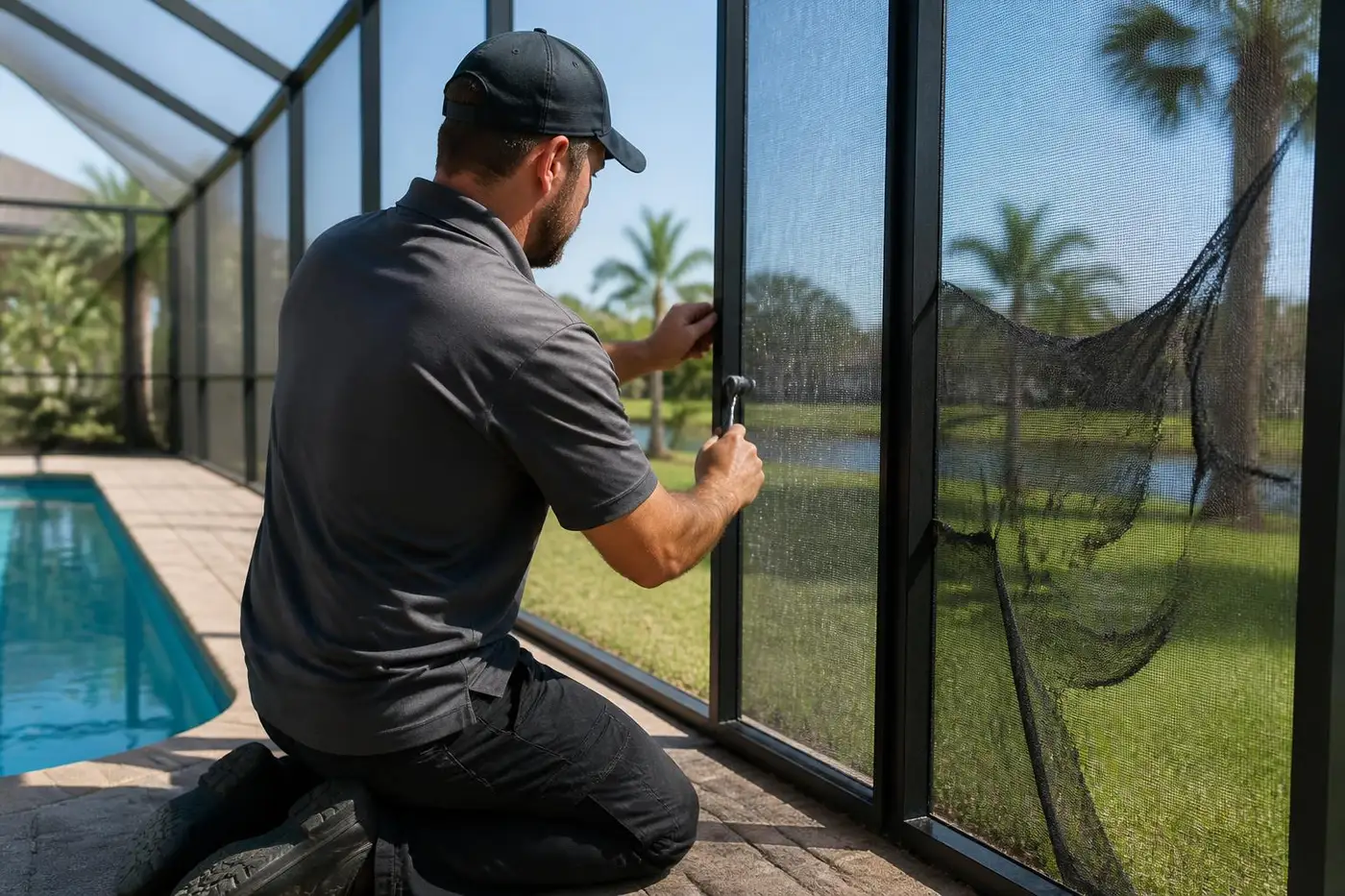
Screen enclosure repair is broader than just patching a hole in the mesh. It can mean re-tensioning and re-spline-ing individual panels, straightening or replacing bent aluminum framing members, resetting panels that have popped out of their tracks, tightening or replacing corroded self-tapping screws, and rebuilding kickplate sections at the base where rot or rust has taken hold.
On older enclosures, especially those built before stricter Florida Building Code wind provisions, we also look at how the structure is anchored - tapcons into the slab, ties into the house framing, and whether previous patch jobs were done correctly or just cosmetically.
Hardware is its own category of repair. Corroded screws bleeding rust streaks down the frame usually call for rusted fastener replacement, while a cage where the original screws have backed out or stripped their holes is a job for pool cage screw replacement or a full screen enclosure fastener replacement pass across every connection point.
Why Jacksonville Enclosures Need More Frequent Repair
Northeast Florida's climate is hard on outdoor structures. Afternoon thunderstorms from June through September bring wind gusts that flex panels and loosen spline. Salt air drifting in from the Intracoastal and the beaches accelerates corrosion on fasteners and frame joints, even on enclosures ten or more miles inland. Add in pollen season coating and staining screens every spring, and long stretches of UV exposure that make standard fiberglass mesh brittle after several years, and it's easy to see why enclosures here age faster than the same structure would in a drier, cooler climate.
Storm wind
Gusts during Jacksonville's thunderstorm and hurricane season flex panels and work fasteners loose over time.
Salt air corrosion
Coastal and Intracoastal moisture attacks uncoated screws, spline channels, and frame connectors.
UV breakdown
Standard fiberglass screen becomes brittle and starts splitting after years of Florida sun.
Pollen and debris
Spring pollen and oak debris load down mesh and stain panels, hiding early tears.
Common Symptoms We See
The most common calls are for torn or ballooning screen panels, frame sections that have separated at the corners, doors that no longer latch because the frame has racked out of square, and kickplates that have rusted through at the base. On older cages, we also see panels where the spline has simply dried out and released the mesh even though the screen itself is still in decent shape.
Repair vs. Replacement
Most enclosure problems are repairable without touching the whole structure. If the aluminum frame is straight, square, and free of significant corrosion, we can usually re-screen individual panels, swap out a damaged frame section, or rebuild a kickplate run. We start recommending broader replacement when the frame itself is bowed or twisted from a storm, when corrosion has weakened multiple structural connections, or when most of the mesh across the enclosure has aged out at the same time, which makes a panel-by-panel approach less cost-effective than a full re-screen.
When the frame is sound but the connections have loosened, screen enclosure structural repairs and added screen enclosure reinforcement are usually the better value than a rebuild. If the aluminum is structurally fine but looks tired, screen enclosure painting and screen enclosure restoration can bring the finish back without replacing extrusion.
Mesh and Frame Options
For re-screening, standard 18x14 fiberglass mesh is the most common and economical choice for general enclosures. Homeowners dealing with gnats and no-see-ums along the coast often upgrade to 20x20 no-see-um mesh, which blocks smaller insects but reduces airflow slightly. Pet owners frequently choose reinforced pet screen around lower panels where dogs and cats tend to test the screen. For sections that need shade or privacy, solar and privacy mesh options cut glare and block sightlines while still allowing airflow.
On the frame side, repairs typically use matching aluminum extrusion profiles so the fix blends with the existing structure, along with stainless steel or coated self-tapping screws to resist the corrosion that plain steel fasteners can't handle in this climate.
Households with pets often move up to pet-resistant screen, homes fighting gnats choose no-see-um screen, and anyone wanting to block sightlines from a neighboring yard can look at privacy screen installation. A straight mesh swap with no frame work is handled as screen mesh replacement.
Our Repair Process
We start with an on-site inspection of the full enclosure, not just the panel you called about, since problems often cluster in areas exposed to the most wind or sun. From there we identify which panels need new mesh, which frame sections need straightening or replacement, and whether kickplates or anchors need attention. Repairs are made using spline rollers to properly seat new screen into the channel, matching hardware for any frame work, and a final check of doors and latches to confirm everything operates correctly before we finish up.
Planning for Cost
Repair costs vary with the number of panels involved, whether frame work is needed in addition to screen, and the mesh type you choose. A handful of torn panels with fiberglass mesh is a modest repair; a full cage with corroded framing and doors that need rebuilding is a bigger project. We provide a free, no-obligation estimate after seeing the enclosure in person so you have real numbers to plan around instead of a rough guess over the phone.
Service Guide
How we diagnose screen enclosure damage
A useful screen enclosure repair starts with a walk-around inspection, not a guess from the driveway. We look at each panel from both sides in daylight, checking for pinholes, frayed edges along the spline channel, sagging mesh, and stretched or torn corners where wind load concentrates stress. Panels near roof valleys, gutters, or tree canopies often show different wear patterns than panels on open exposures, so the inspection has to account for where the enclosure sits on the lot.
Beyond the mesh itself, we check the aluminum framing for loose screws, corroded fasteners, bowed verticals, and gaps at the base track where debris and water can collect. A single torn panel is sometimes a symptom of a frame problem rather than a mesh problem, and treating the symptom without checking the cause usually means a repeat visit within a season.
Panel-by-panel check
Each screen panel is inspected individually since wear varies by exposure, shade, and proximity to trees or sprinklers.
Spline groove condition
Cracked or brittle spline channels are noted separately from mesh tears because they change the repair approach.
Frame alignment
Bowed or shifted framing members are flagged before any new mesh goes in, since installing over a bad frame wastes material.
Choosing the right mesh for a Jacksonville patio
Screen enclosure repair almost always comes with a mesh decision. Standard fiberglass mesh is the common baseline for patio and lanai enclosures because it's affordable and easy to work with, but it doesn't hold up as well against pets or heavy pollen buildup. Pet-resistant mesh uses a heavier vinyl-coated weave that resists claws and rubbing, which matters if a dog spends time on the porch. No-see-um mesh has a tighter weave that blocks small biting insects common in humid coastal air, though the tighter weave can reduce airflow slightly and shows pollen film faster.
Solar or shade screening is a different category altogether, cutting glare and heat on west-facing patios, but it's heavier and generally not interchangeable with standard insect screen without checking the frame's spline groove depth. Matching mesh type to how the space is actually used prevents a redo a year later.
Frame, spline, and hardware considerations
The aluminum extrusions holding the screen are only part of the system. Spline size has to match the groove width or the mesh will pop loose under wind pressure within months. Fasteners at panel corners and along base tracks corrode over time in Jacksonville's humidity, especially where dissimilar metals meet, and replacing a handful of screws during a repair visit is far cheaper than addressing a frame failure later.
If the enclosure includes an access door, hinges, closers, latches, and the door sweep at the bottom all wear on a different schedule than the screen panels. A door that no longer latches or sags on its hinges lets in insects regardless of how new the mesh is, so door hardware gets checked as part of any repair scope, not treated as separate.
Repair sequence and what to prepare before the visit
A typical repair sequence starts with clearing furniture, planters, and rugs away from the panels being worked on, since spline tools and rubber mallets need clear access along the frame edge. Old mesh and spline are stripped from the channel, the groove is cleaned of debris and old adhesive residue, and the new mesh is stretched, rolled into the spline groove, and trimmed flush.
Homeowners can help move the job along by unlocking gates ahead of time, restraining pets during the visit, and noting any panels that seem especially loose or noisy in wind so those get extra attention. Weather matters too — mesh installs best in dry, moderate conditions, since heat can make the vinyl coating on pet-resistant mesh tacky and humidity can affect spline seating.
What drives the cost of a repair
Planning-level cost for screen enclosure repair depends mainly on the number of panels affected, the mesh grade chosen, and how much frame work is needed alongside the screen itself. A single small tear patched or rescreened costs far less than repairing a section with multiple torn panels plus corroded fasteners. Access also plays a role — second-story or hard-to-reach panels take longer than ground-level lanai screens.
Getting an accurate range means describing the number of damaged panels, roughly how old the enclosure is, and whether any frame bowing or hardware issues have been noticed, rather than trying to estimate from a general square footage figure.
Maintenance that extends the life of a repair
New mesh and spline last longer with basic upkeep. Rinsing panels with a garden hose every few months clears pollen and salt air residue before it embeds in the weave. Trimming back tree limbs that brush against panels prevents repeat abrasion damage in the same spots. Checking the base track for standing water or leaf buildup after storms keeps moisture from sitting against the frame.
A quick seasonal look at spline edges and corner fasteners can catch a loose section before it becomes a full tear, which keeps future repairs small and localized instead of turning into a larger rescreen project.
Repair versus full rescreen for a standard enclosure
Spot repair makes sense when damage is limited to one or two panels and the surrounding mesh and frame are still sound. Full rescreening becomes the more sensible option when several panels show age-related brittleness, when mesh color has faded unevenly panel to panel, or when the enclosure hasn't been rescreened in many years and one repair is likely to be followed by another nearby within months.
During hurricane season, this decision carries extra weight. An enclosure with multiple weak panels is more likely to suffer a cascading tear during high wind, so evaluating the whole structure before storm season rather than patching reactively afterward is generally the more practical approach.
Keep Reading
Related services to compare
Fix it first: Pool Enclosure Repair
Targeted fixes for torn screen, damaged panels, doors, frames, hardware, and storm damage.
Storm Damage Screen Enclosure Repair in Jacksonville
Targeted fixes for torn screen, damaged panels, doors, frames, hardware, and storm damage.
Repair option: Screen Enclosure Repair Cost
Targeted fixes for torn screen, damaged panels, doors, frames, hardware, and storm damage.
Fresh mesh with Screen Enclosure Rescreening
Fresh mesh across a panel, a wall, or an entire pool cage, with the screen type matched to how you use the space.
Screen Enclosure Installation for Jacksonville homes
New pool cages, pool enclosures, lanais, screened patios, screen rooms, and custom aluminum structures.
Planning Pool Enclosure Installation
New pool cages, pool enclosures, lanais, screened patios, screen rooms, and custom aluminum structures.
Local Coverage
Screen Enclosure Repair across the Jacksonville area
Screen Enclosure Repair in St. Johns
Screen Enclosure Repair in Fruit Cove
Screen Enclosure Repair in Julington Creek
Screen Enclosure Repair in Mandarin
Screen Enclosure Repair in Ponte Vedra Beach
Screen Enclosure Repair in Nocatee
Screen Enclosure Repair in Jacksonville Beach
Screen Enclosure Repair in Orange Park
Screen Enclosure Repair in St. Augustine
Screen Enclosure Repair in Atlantic Beach
Screen Enclosure Repair in Neptune Beach
Screen Enclosure Repair in World Golf Village
Screen Enclosure Repair in Green Cove Springs
Screen Enclosure Repair in Middleburg
Screen Enclosure Repair in Fleming Island
Screen Enclosure Repair in Rivertown
FAQ
Screen Enclosure Repair questions
Can you repair just one section of my enclosure without redoing the whole thing?+
Yes, in most cases. If the frame is structurally sound, we can re-screen or repair individual panels without touching the rest of the enclosure.
How long does a typical screen enclosure repair take?+
Small panel repairs can often be done in a single visit. Larger jobs involving frame work or multiple panels may take longer depending on scope.
Do you match the existing screen mesh and frame color?+
We work with standard mesh types and aluminum extrusion profiles to match your existing enclosure as closely as possible.
Is my enclosure repairable or does it need full replacement?+
It depends on the condition of the frame. Straight, square framing with isolated screen or hardware damage is usually repairable; widespread corrosion or storm-bent framing often points toward replacement.
Do you handle both pool cages and patio or lanai screen rooms?+
Yes, we repair pool enclosures, lanai screen rooms, and patio enclosures throughout Jacksonville and Northeast Florida.
What causes screens to fail so quickly in Jacksonville?+
UV exposure, salt air near the coast, storm winds, and pollen buildup all accelerate wear on screen mesh and hardware compared to less harsh climates.
Can you repair storm damage to my enclosure?+
Yes, we assess storm damage, straighten or replace bent framing, and re-screen any torn panels as part of the repair.
Call (904) 853-3510 for a free estimate on repairing your screen enclosure.
Request an estimate