Full Enclosure Replacement
Screen Enclosure Replacement in Jacksonville, FL
Full teardown and rebuild for Jacksonville screen enclosures too far gone for patch repairs.
A screen enclosure replacement means taking down the existing aluminum frame and screen panels down to the footers or slab anchors and building new. That's a different job than a rescreen, where the frame stays and only the mesh is swapped, and different again from a spot repair where a panel or two gets patched. Replacement gets called for when the aluminum itself has failed - corroded extrusion, bent or bowed panels, pulled anchors, or a frame that was undersized for Northeast Florida wind loads to begin with.
Jacksonville homeowners run into this most often after a named storm has pushed an already-aging enclosure past the point of economical repair, or when a screen porch or lanai enclosure was built decades ago under an older code cycle and the owner wants something that will hold up to current Florida Building Code wind speed requirements. Salt air near the beaches communities, years of afternoon thunderstorm cycles, and UV exposure all shorten the working life of aluminum screen enclosures, and eventually the frame reaches a point where new mesh on old aluminum just isn't worth doing.
This page walks through how we tell repair from replacement, what a full teardown and rebuild actually involves, the frame and mesh choices you'll make along the way, and roughly how Jacksonville homeowners should think about planning the cost.
Repair, Rescreen, or Full Replacement: How We Decide
The decision usually comes down to the aluminum, not the screen. Screen mesh is the cheapest, easiest part of an enclosure to swap out, so if the frame is straight, square, and free of corrosion, a rescreen almost always beats a full replacement on cost. The harder call is what to do when the frame itself is compromised.
We look at a handful of things on site: whether the extrusion is pitted or crumbling at fastener points, whether panels have racked out of square from wind load or a tree limb impact, whether the kickplate or base track has separated from the slab, and whether prior repairs were done with mismatched screws or gauges that are now failing in a cascade. One or two bad panels next to an otherwise solid frame is a repair. Corrosion or bowing spread across multiple panels, a frame that's been patched three or four times already, or anchors that have worked loose from the slab in more than a couple spots usually points to replacement being the more honest recommendation, even though it costs more up front.
Repair candidate
Isolated torn panels, one bent screen frame member, loose spline in a handful of spots, frame otherwise straight and anchored
Replacement candidate
Widespread corrosion at fastener holes, multiple bowed or racked panels, pulled anchors on the slab, undersized framing for current wind zone
Gray area
Older enclosures with sound aluminum but heavy pitting - often worth a frame inspection before committing either way
Partial Rebuild vs. Full Teardown
Not every replacement means starting from the slab up. A partial rebuild replaces the roof panels or one damaged wall section while keeping sound existing framing, superstructure, and footers intact. This works when the damage or corrosion is contained to one area - say a roof section that took debris impact while the pool cage walls are still structurally fine. It costs less than a full teardown and takes less time, but it only makes sense when the remaining aluminum is genuinely sound, not just cosmetically okay.
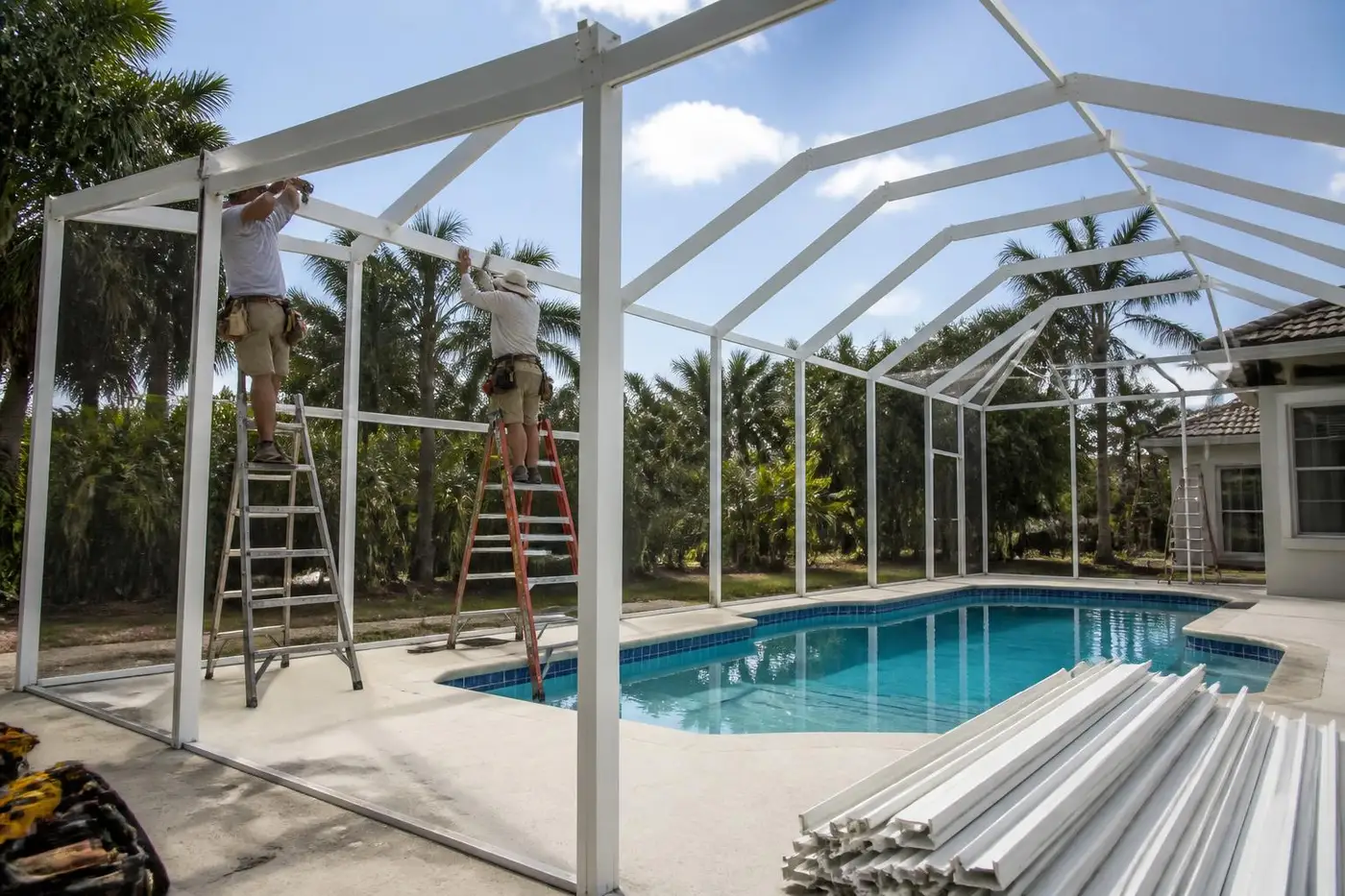
A full teardown removes every panel, every frame member, and typically the base track and anchors, then rebuilds the enclosure from the ground up on the existing footprint or slab. We recommend this when corrosion or storm damage is spread across the structure, when the existing frame doesn't meet current wind load requirements for the property's exposure category, or when the homeowner wants to change the shape, add a super gutter, or reconfigure door openings - changes that are hard to do cleanly with a partial approach. Full rebuilds also let us correct old mistakes: undersized fasteners, missing kickplates, or a base track that was never properly sealed to the slab.
What Changes When an Older Enclosure Gets Rebuilt to Current Standards
Enclosures built in Jacksonville twenty or thirty years ago were engineered to whatever wind load standard applied at the time, and that standard has been revised more than once since. When we rebuild an older enclosure, the new structure typically has to meet the current Florida Building Code wind speed and exposure requirements for the site, which usually means heavier gauge aluminum extrusion, closer spacing on structural members, and anchor patterns sized for higher pull-out resistance than what's coming down.
That translates into a few visible differences: thicker frame members that read a bit more substantial than the original, stainless steel fasteners in place of the mixed hardware that often accumulates over years of patch repairs, and in many cases a permit pulled with the local building department where the original enclosure may have predated permitting records. It's worth knowing going in that a rebuild is not simply swapping old aluminum for identical new aluminum - it's an opportunity, and usually a requirement, to bring the structure up to what code calls for today.
Common Problems That Lead to a Replacement Call
Corrosion at fastener points is the most common driver. Jacksonville's humidity and, closer to the coast, salt-laden air accelerate galvanic corrosion where dissimilar metals meet - a coated screw in bare aluminum, for instance. Once that starts, patch repairs buy limited time before the surrounding metal fails too.
Storm damage is the other big one. Tree limbs, wind-driven debris, and straight-line wind gusts during summer thunderstorms or a tropical system can bow panels, tear mesh across wide sections, and rack the frame out of square. A racked frame is a structural issue, not a cosmetic one, and it's usually what pushes a job from repair into replacement territory.
Frame and Mesh Options for the New Enclosure
On the frame side, most replacements use standard mill-finish or painted aluminum extrusion sized to the engineering required for the property's wind exposure. Bronze or white are the common finish choices for Northeast Florida homes, and we'll match or intentionally depart from the existing house trim depending on what the homeowner wants.
For mesh, 18x14 fiberglass screen is the standard workhorse and the most economical option. 20x20 no-see-um mesh cuts down on the tiny biting gnats that show up seasonally near marsh and coastal areas, at some cost to airflow and visibility. Pet screen is a heavier, tear-resistant weave worth considering for households with dogs or cats that lean against the panels. Solar or privacy mesh reduces glare and heat gain around a pool cage but limits airflow more than standard screen, so it's a tradeoff worth discussing panel by panel rather than across the whole enclosure.
The Replacement Process Step by Step
The work generally follows the same sequence: site evaluation and measurement, engineering and permitting where required, teardown of the existing screen and frame, inspection and repair or replacement of the base track and anchor points, assembly of new framing on site, installation of the chosen mesh with spline, and a final walkthrough covering door alignment and hardware.
Timeline depends heavily on permitting. A straightforward rescreen-scale job can happen in a day or two, but a full enclosure replacement that requires engineered drawings and a permit review from the local jurisdiction can take several weeks from signed estimate to finished install, mostly waiting on plan review rather than active labor.
Florida Weather Factors That Drive This Decision
Sun and UV exposure break down screen mesh and, over long enough time, weaken aluminum coatings, which is part of why even a well-built enclosure eventually needs attention. Humidity accelerates corrosion at any point where fasteners meet aluminum, especially if the wrong hardware was ever used. Hurricane season adds direct storm risk in the form of wind-driven debris and sustained gusts that test every anchor point and frame joint. Near the beaches and Intracoastal, salt air speeds up corrosion further, which is one reason coastal Jacksonville enclosures often need replacement sooner than inland ones of the same age. Pollen season doesn't damage the structure, but heavy spring pollen loads can make screen replacement timing worth planning around if visibility and cleaning are a concern.
Planning the Cost of a Replacement
Replacement costs more than a rescreen because you're paying for engineering, aluminum, fasteners, and labor to remove and rebuild the entire structure, not just re-tension mesh. Major cost drivers include the size and shape of the enclosure, the height and wind load engineering required, whether a permit and inspection are needed, the mesh grade chosen, and whether the base track and anchors need full replacement or just localized repair.
We don't quote firm numbers without seeing the site, since two enclosures of similar size can price very differently depending on frame condition, access, and code requirements. A site visit and written estimate is the only reliable way to get planning numbers for your specific enclosure.
Keep Reading
Related services to compare
Extend its life with Screen Enclosure Fastener Replacement
Doors, reinforcement, fasteners, painting, and restoration work that extends an enclosure's usable life.
Pool Enclosure Replacement explained
Full replacements and rebuilds when an aging or storm-damaged enclosure is past practical repair.
Full rebuild: Aluminum Enclosure Replacement
Full replacements and rebuilds when an aging or storm-damaged enclosure is past practical repair.
When repair is done: Hurricane Damaged Screen Enclosure Replacement
Full replacements and rebuilds when an aging or storm-damaged enclosure is past practical repair.
Screen Enclosure Repair in Jacksonville
Targeted fixes for torn screen, damaged panels, doors, frames, hardware, and storm damage.
Repair option: Screen Panel Replacement
Targeted fixes for torn screen, damaged panels, doors, frames, hardware, and storm damage.
Local Coverage
Screen Enclosure Replacement across the Jacksonville area
Screen Enclosure Replacement in St. Johns
Screen Enclosure Replacement in Fruit Cove
Screen Enclosure Replacement in Julington Creek
Screen Enclosure Replacement in Mandarin
Screen Enclosure Replacement in Ponte Vedra Beach
Screen Enclosure Replacement in Nocatee
Screen Enclosure Replacement in Jacksonville Beach
Screen Enclosure Replacement in Orange Park
Screen Enclosure Replacement in St. Augustine
Screen Enclosure Replacement in Atlantic Beach
Screen Enclosure Replacement in Neptune Beach
Screen Enclosure Replacement in World Golf Village
Screen Enclosure Replacement in Green Cove Springs
Screen Enclosure Replacement in Middleburg
Screen Enclosure Replacement in Fleming Island
Screen Enclosure Replacement in Rivertown
FAQ
Screen Enclosure Replacement questions
How do you decide between repairing my enclosure and replacing it?+
We inspect the aluminum frame, not just the screen. Isolated panel damage on an otherwise straight, well-anchored frame usually gets repaired. Widespread corrosion, racked panels, or pulled anchors point toward replacement.
Can part of my enclosure be rebuilt while the rest stays as is?+
Yes, if the remaining framing is structurally sound. A partial rebuild replaces a damaged section - a roof or one wall - while keeping the rest of the existing structure and footers intact.
Will a rebuilt enclosure need a permit?+
Many full replacements require a permit and engineered drawings under current Florida Building Code, especially where the structure is being rebuilt to meet updated wind load requirements. We'll tell you upfront if your job needs one.
Does replacing my enclosure mean it will look different from the original?+
Often slightly, yes. Current code requirements can call for heavier gauge framing and different fastener types than what was used decades ago, so a rebuilt enclosure may look a bit more substantial than the original.
How long does a full enclosure replacement take?+
Active construction is usually a matter of days to a couple weeks depending on size, but permitted jobs often take several weeks total once you factor in plan review and inspection scheduling.
What mesh options do I have on a replacement?+
Standard 18x14 fiberglass, 20x20 no-see-um for smaller pests, heavier pet screen for households with animals, and solar or privacy mesh for glare and heat reduction are all options we can discuss panel by panel.
Will my homeowners insurance cover a replacement after storm damage?+
That depends on your policy and the cause of damage, which we can't determine for you. We can provide photos, measurements, and a written estimate you can submit to your insurer or adjuster for their review.
Can I get a rescreen instead if I'm not sure replacement is needed?+
Absolutely - we'll evaluate the frame first and recommend the least invasive option that will hold up, whether that's a rescreen, a partial rebuild, or a full replacement.
Request a free, no-obligation estimate and we'll tell you honestly whether your Jacksonville enclosure needs a repair, a rescreen, or a full replacement.
Request an estimate