Local Screen Repair Across Jacksonville
Screen Enclosure Repair Jacksonville, FL
Tell us what is damaged and request an estimate.
Why Jacksonville Homeowners Choose Us
Straightforward service, practical repair options, and help for everything from torn screen panels to complete pool enclosure projects.
Free Estimates
Request a straightforward estimate for screen repair, rescreening, replacement, or a new enclosure before deciding how to move forward.
Repair-First Approach
We evaluate the condition of the enclosure first and explain whether repair, rescreening, restoration, or replacement makes the most sense.
Repair & New Installation
From individual torn panels and screen doors to full pool cages, lanais, patios, and new screen enclosure installations.
Jacksonville Area Service
Serving Jacksonville and surrounding Northeast Florida communities with mobile screen enclosure repair and installation service.
Florida-Ready Solutions
Screen, hardware, and enclosure options selected with Jacksonville sun, humidity, storms, insects, and outdoor living in mind.
Clear Project Options
Understand your repair, rescreening, replacement, and installation options before committing to the project.
Need Screen Enclosure Help?
Whether you need a small screen repair, full rescreen, replacement, or a brand-new enclosure, request an estimate and tell us about your project.
Jacksonville Screen Enclosure Repair Made Simple
Screen Repairs Built for Jacksonville Outdoor Living
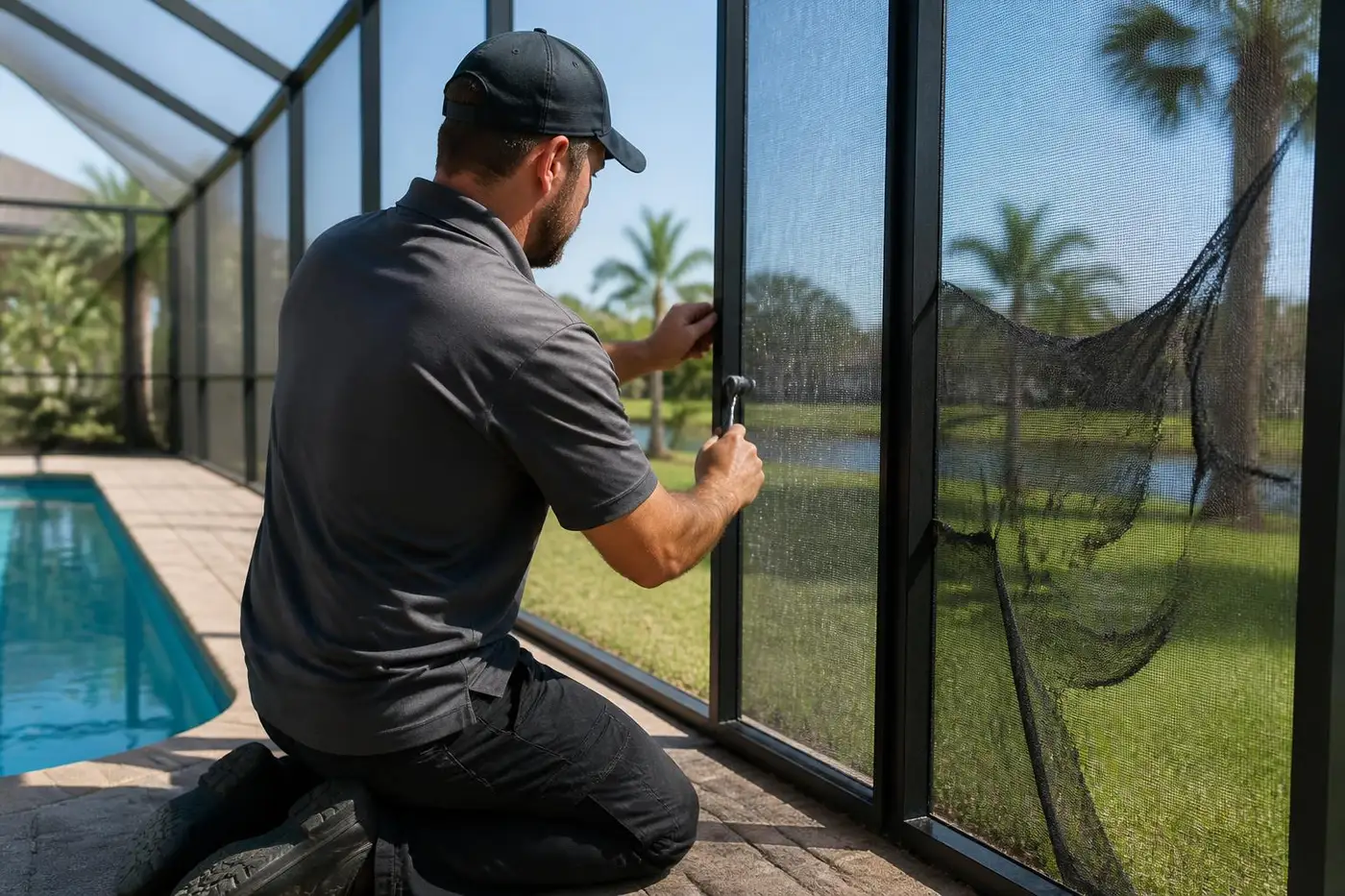
A damaged enclosure can turn a comfortable pool deck, lanai, or patio into a constant source of frustration. We handle screen enclosure repair Jacksonville FL homeowners actually need: torn mesh that lets mosquitoes and debris inside, loose spline that leaves panels flapping in the wind, and doors that no longer close properly. If you have been searching for screen repair Jacksonville homeowners can schedule quickly, we cover every screen enclosure Jacksonville FL properties commonly have — pool cages, lanais, screened patios, porches, and screen rooms — with practical, honest repair options first.
Jacksonville screen repair work here spans pool screen and enclosure repair, pool cage repair and rescreening, lanai and patio screens, individual screen panels, and screen doors. Whether you have one torn panel or an enclosure with widespread wear after years of Florida sun and storms, we look at the condition of the whole system and explain what makes sense to repair. For help planning your next repair, start with a straightforward estimate request.
Core Services
Repair, Rescreen, Restore, Replace, Build New
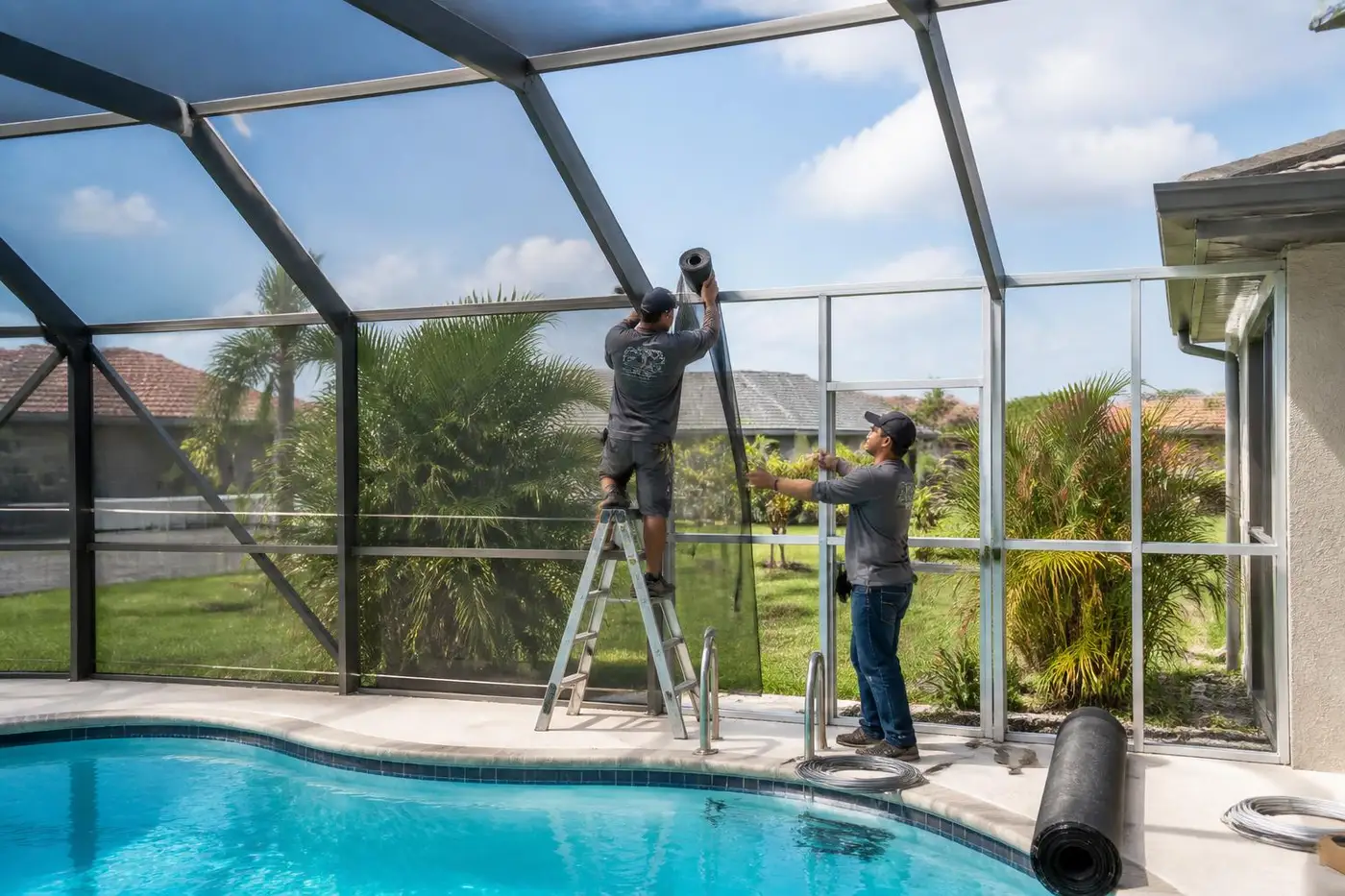
Our service mix is intentionally focused on the screen components Jacksonville homeowners need repaired most often. We repair torn and loose enclosure screens, address pool screen and pool cage problems, replace worn panels, restore screen doors, and rescreen larger sections when isolated repairs no longer make sense. We also work on lanais and screened patios where ripped mesh, loose edges, damaged lower panels, or troublesome doors are interfering with daily use. When an enclosure is beyond practical repair, we design and build new screen enclosures, pool cages, lanais, and screened patios engineered for Florida wind loads. Each project starts by looking at the actual condition of the enclosure instead of assuming a full replacement is necessary. Most Jacksonville homeowners start with a repair; when an enclosure is past that point we rescreen, restore, replace, or build a new one.
Repair
Screen Enclosure Repair
Panel, frame, and hardware repair for pool cages, lanais, and patio enclosures across Jacksonville.
Screen Enclosure Repair Jacksonville →New Enclosures
Screen Enclosure Installation
New screen enclosure construction in Jacksonville, from site layout through final mesh install.
New Screen Enclosure Installation Jacksonville →Repair
Pool Screen Repair
Re-screening and panel repair to keep bugs and debris out of your Jacksonville pool.
Pool Screen Repair Jacksonville →New Enclosures
Pool Cage Installation
Full pool cage construction, from footings and framing to mesh and doors.
Pool Cage Construction Jacksonville →Repair
Pool Cage Repair
Aluminum frame and hardware repair to keep your pool cage sound and square.
Pool Cage Repair Jacksonville →Rescreening
Pool Cage Rescreening
Full or partial pool cage rescreening to fix tears, sagging mesh, and sun-damaged panels.
Pool Cage Rescreening Jacksonville →Replacement
Screen Enclosure Replacement
Full teardown and rebuild for Jacksonville screen enclosures too far gone for patch repairs.
Screen Enclosure Replacement Jacksonville →Repair
Storm Damage Screen Enclosure Repair
Fast repair for enclosures damaged by Jacksonville's thunderstorms, tropical systems, and high wind.
Storm Damage Screen Repair Jacksonville →Repair
Targeted fixes for torn screen, damaged panels, doors, frames, hardware, and storm damage.
Rescreening
Fresh mesh across a panel, a wall, or an entire pool cage, with the screen type matched to how you use the space.
New Enclosures
New pool cages, pool enclosures, lanais, screened patios, screen rooms, and custom aluminum structures.
Replacement
Full replacements and rebuilds when an aging or storm-damaged enclosure is past practical repair.
Upgrades & Restoration
Doors, reinforcement, fasteners, painting, and restoration work that extends an enclosure's usable life.
Quick Links
Popular Screen Services in Jacksonville
The work Jacksonville homeowners ask for most, from tighter no-see-um mesh to a full pool cage build.
- No-See-Um Screen Installation Jacksonville
- Lanai Screen Repair Jacksonville
- Patio Screen Repair Jacksonville
- Pool Cage Rescreening Jacksonville
- Screen Door Repair Jacksonville
- Pool Cage Construction Jacksonville
- Custom Pool Enclosures Jacksonville
- Patio Screen Enclosures Jacksonville
- Screen Enclosure Rescreening Jacksonville
Most Requested
What Jacksonville Homeowners Search For
Looking for screen enclosure repair near me, repair prices, or a mobile crew that comes to your address? These are the pages people ask for most.
Planning Tool
Screen Enclosure Repair Cost Calculator Jacksonville FL
Use this calculator to get a rough planning range based on enclosure size, number of damaged panels, screen type, frame condition, height, and repair complexity. It is built from the same factors we price in the field for screen enclosure repair Jacksonville FL homeowners actually book — from a single torn bay to a full pool cage rescreen.
1. Enclosure type
2. Approximate enclosure size
3. Number of damaged screen panels
4. Screen type
5. Damage type (select all that apply)
6. Frame condition
7. Door or gate repair needed?
8. Roof screen panels damaged?
9. Enclosure height
10. Full rescreen being considered?
11. Storm-related damage?
Estimated Screen Enclosure Repair Range
$175 – $500
Multiple-panel repair
Only the damaged panels are re-meshed, keeping sound screening in place.
This calculator provides a general planning estimate only. Actual pricing depends on enclosure measurements, number and location of damaged panels, screen material, enclosure height, frame condition, access, hardware, storm damage, and whether individual repairs or full rescreening are needed.
Want the detail behind these numbers? See our screen enclosure repair cost Jacksonville breakdown or pool cage rescreening Jacksonville FL pricing.
What Affects Screen Enclosure Repair Cost in Jacksonville?
Number of damaged panels
One torn bay is a short visit. Once several bays are involved, the mesh, spline, and labor scale together and pool screen panel replacement Jacksonville pricing starts to approach a partial rescreen.
Enclosure size
A small screened porch and a large two-story pool cage use the same technique but very different quantities of material and staging time.
Screen type
Standard fiberglass is the baseline. Tighter no see um screen installation Jacksonville and heavier pet-resistant mesh cost more per square foot and take more tension to set cleanly.
Enclosure height
Tall cages need ladders, staging, or lifts, and panels are longer, so the same tear costs more to reach on a two-story enclosure than at eye level.
Roof screen panels
Roof screening is overhead work above the beams and is priced separately from wall panels. See screen enclosure roof repair.
Frame condition
Bent uprights, cracked corners, and corrosion at the slab require screen enclosure frame repair Jacksonville before new mesh will hold tension.
Doors and hardware
Rollers, closers, latches, and kick plates are their own line item. Screen door repair is often bundled into a mesh visit at lower combined cost.
Storm damage
Wind events usually damage panels, fasteners, and framing together. Pool cage storm damage repair Jacksonville work is scoped and documented for insurance where relevant.
Access
Tight side yards, screened-in equipment, heavy landscaping, and pool decks with no staging room all add time to an otherwise routine repair.
Partial vs full rescreening
Re-meshing one elevation costs far less than the whole cage, but repeated partial visits can add up past a single pool cage rescreening Jacksonville FL job.
Decision Tool
Should I Repair or Rescreen My Pool Cage?
Answer a few questions about the condition of your screens and enclosure to see whether individual panel repairs, partial rescreening, or full rescreening may make the most sense. It is the same triage we run on a pool cage repair Jacksonville FL site visit.
1. How many panels are damaged?
2. Are multiple screens brittle, faded, or tearing easily?
3. Is spline pulling loose or failing in multiple areas?
4. Has the enclosure had repeated panel repairs?
5. Is the screen more than several years old?
6. Is there storm damage?
7. Are roof panels damaged?
8. Is there frame damage, bending, or corrosion?
9. Do you want to upgrade to no-see-um or pet-resistant screen?
10. Are doors or gates also damaged?
Suggested Direction
Individual Panel Repair May Be Enough
One or two torn bays with sound mesh elsewhere is the simplest case: pull the old spline, set new screening square, and roll it back in. There is no benefit to rescreening an enclosure that is otherwise holding up well.
screen enclosure repair Jacksonville FL · lanai screen repair Jacksonville FL
Individual Panel Repair vs Full Pool Cage Rescreening
One or two torn bays on an enclosure whose remaining screening still has tension is a repair, plain and simple. The panel is re-meshed, the spline is rolled back in, and nothing else is disturbed — the cheapest honest answer, and the one most pool screen repair Jacksonville FL calls end with.
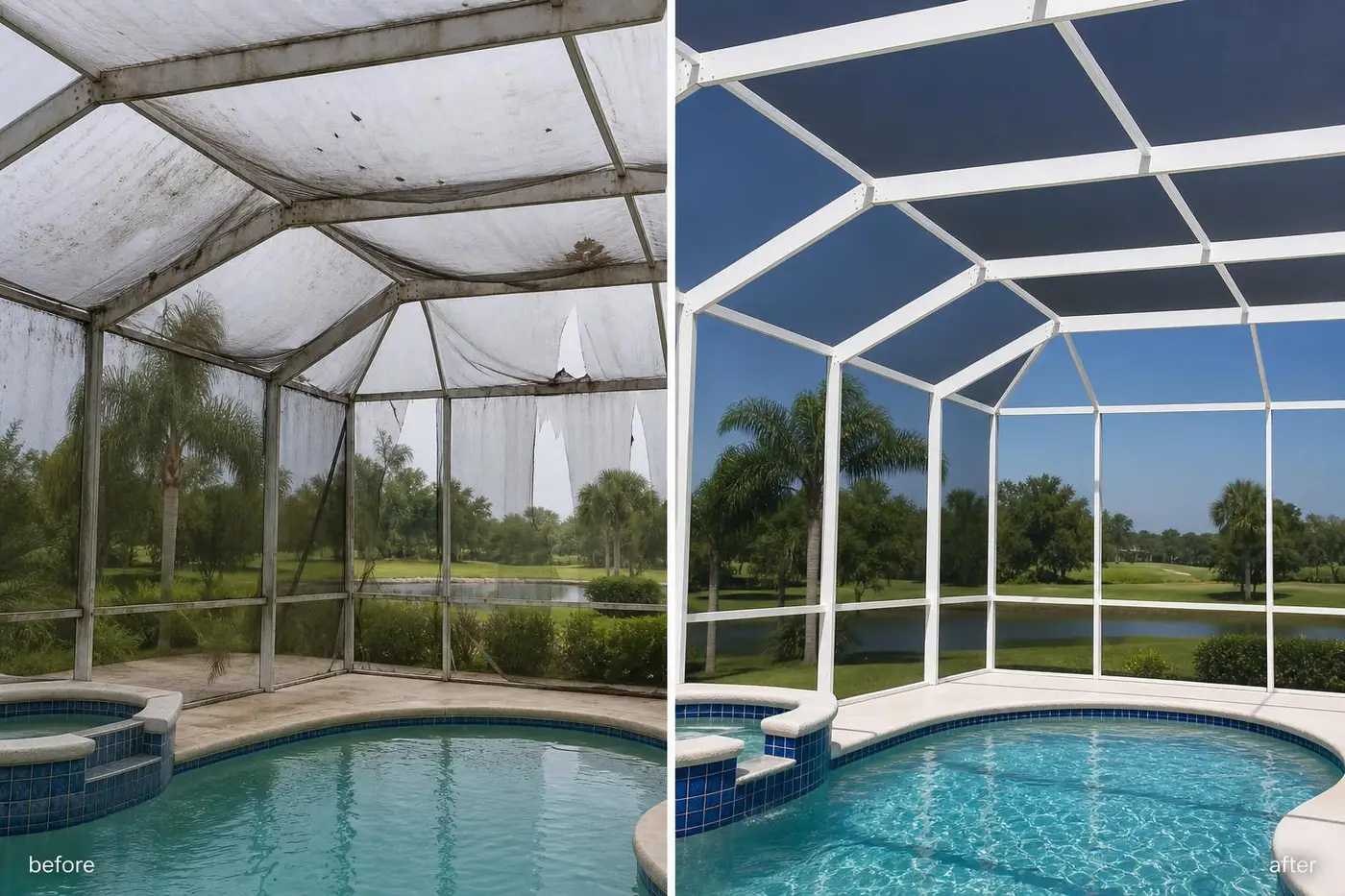
The picture changes when the same cage keeps coming back. Repeated panel failures in different bays usually mean the mesh has reached the end of its service life rather than being unlucky. Brittle, chalky, or sun-faded screening tears at the spline groove as soon as it is re-tensioned, and neighboring panels tend to fail within months.
Spline failure across multiple areas points the same direction. When the rubber has shrunk and hardened in several bays, each repair loosens the run beside it. At that point a screen enclosure rescreening of a whole elevation is usually less expensive over two years than four separate visits.
Widespread storm damage is its own case. If wind pulled panels out of several bays, bent a few uprights, and opened the roof screening, patching individual bays leaves an enclosure with mismatched mesh age and unresolved structural stress.
Upgrading material is the other common reason to rescreen early. If you want no-see-um weave along the marsh side or pet-resistant mesh on the lower panels, doing it during a full pool cage rescreening costs far less than converting a panel at a time.
How much does it cost to rescreen a pool cage in Jacksonville? Most fall between about $1,400 and $4,300 depending on size and height, which is why we tell homeowners with three good years of mesh left to keep repairing, and homeowners chasing their fifth tear to rescreen once and stop paying twice.
Screen Options for Jacksonville Pool Cages and Lanais
There is no single best mesh. Each option trades airflow, visibility, insect protection, and durability differently, and many Jacksonville enclosures end up with two materials on the same frame.
Standard fiberglass
The 18/14 default: good airflow, clear outward visibility, easy to work with, and the least expensive to replace. It handles normal insects but not no-see-ums or dogs.
No-see-um screen
A tighter 20/20 weave that stops the tiny biting midges common near the marsh and the St. Johns River. Slightly less airflow and a marginally darker view.
Pet-resistant screen
Heavy vinyl-coated polyester that resists claws and pushing along the lower panels. Denser and more visible up close, so it is often used only where pets reach.
Heavy-duty options
Reinforced and solar or privacy meshes add strength, glare control, or shade on west-facing walls. Best used selectively — durability comes at the cost of airflow and clarity.
Related pages: screen enclosure repair, pool cage repair, pool cage rescreening, lanai screen repair, patio screen repair Jacksonville, no-see-um screen installation, screen enclosure frame repair, storm damage repair, service areas, or request an estimate.
New Construction
Need a New Screen Enclosure?
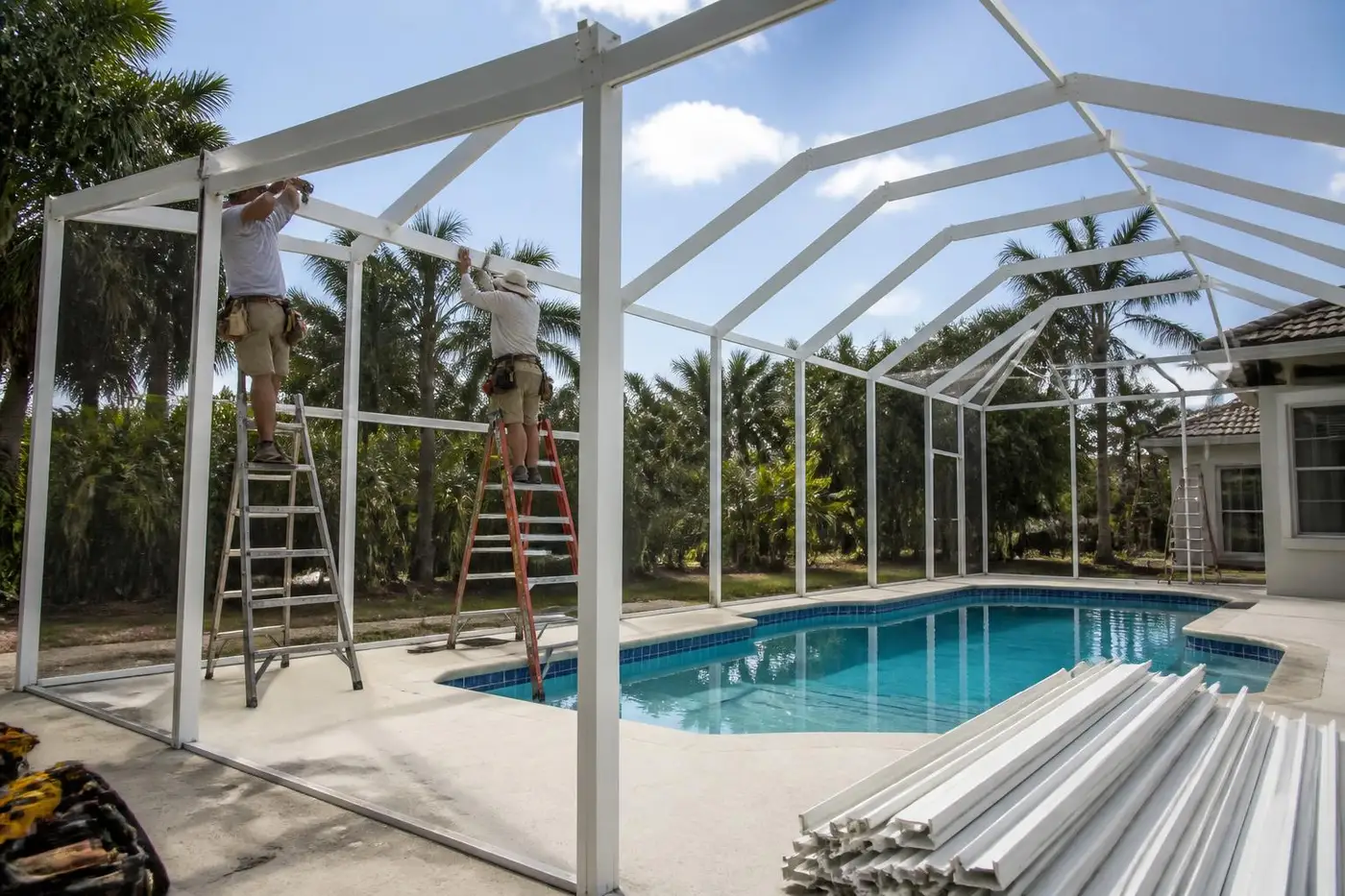
Repair is always the first question we ask, but some enclosures are beyond it — a corroded frame after decades of salt air, a pool cage flattened in a storm, or a bare slab that never had a structure at all. We design and build new screen enclosures, pool cages, lanai enclosures, screened patios, and screen rooms across Jacksonville and the surrounding communities, engineered and permitted for Florida wind loads.
New construction starts with the same site visit as a repair: existing footings and slab edge, deck layout, roof line, drainage, mesh choice, and how you actually plan to use the space. From there we scope the structure honestly — including telling you when a rescreen or partial rebuild would serve you better than a full replacement.
- Pool Cage Construction Jacksonville
- Custom Pool Enclosures Jacksonville
- New Screen Enclosure Installation Jacksonville
- Lanai Enclosure Installation Jacksonville
- Patio Screen Enclosures Jacksonville
- Screened Porch Installation Jacksonville
- Custom Aluminum Screen Enclosures
- Screen Enclosure Replacement Jacksonville
Why Homeowners Call Us
A Practical Repair Standard
Repair-first recommendations
We look for the practical repair before suggesting a larger project. If replacing a few panels makes sense, we explain that instead of automatically recommending a full rescreen.
Focused screen expertise
Our work stays centered on enclosures, pool cages, lanais, panels, and screen doors, so the details of mesh condition, spline, fit, tension, and access receive proper attention.
Clear project scope
You should understand what is being repaired and why. We aim to separate urgent damage from cosmetic wear so you can make a more informed decision.
Jacksonville-area service
Our service is designed around the outdoor spaces and weather conditions common across Jacksonville and surrounding Northeast Florida communities.
Small repairs welcome
Not every job needs to be a complete enclosure project. Individual torn panels, loose screen, and problem doors are valid reasons to call.
New enclosures when repair is not enough
When an enclosure is beyond practical repair or you are starting from a bare slab, we design and install new pool cages, lanais, and screened patios engineered for Florida wind loads.
Service Area
Where We Work
Our primary service area centers on Jacksonville, with regular service extending into St. Johns, Fruit Cove, Mandarin, Ponte Vedra Beach, Nocatee, Jacksonville Beach, Orange Park, St. Augustine, Atlantic Beach, Neptune Beach, World Golf Village, Green Cove Springs, Middleburg, Fleming Island, and Rivertown. Conditions vary across the region. Coastal homes may see more salt exposure and wind, while inland properties can deal with tree debris, insects, sun exposure, and storm damage. The repair approach should reflect what the enclosure is actually facing.
Because we operate as a service-area business, the work comes to you. If you are unsure whether your property falls within the current service area, call (904) 853-3510 and describe where you are located and what needs repair.
About
A Jacksonville-Focused Approach to Screen Repair
Screen Enclosure Repair Jacksonville was built around a simple idea: homeowners should be able to get clear help for screen problems without turning a small repair into a complicated project. The business grew from hands-on repair work around Jacksonville, where screened pools, patios, and lanais are part of everyday life and where sun, humidity, wind, tree debris, and seasonal storms can be hard on mesh, spline, doors, and enclosure components.
Our work is coordinated by a small local team that values careful inspection and straightforward communication. Caleb Morgan oversees customer projects and repair planning, Luis Ramirez coordinates field scheduling and material preparation, and Derrick Hayes focuses on detailed screen and door repairs. The goal is not to push every enclosure toward a complete rescreen. It is to understand what has failed, what is still performing well, and which repair approach gives the homeowner the most sensible result.
Mesh Options
Which Screen Material Fits Your Enclosure
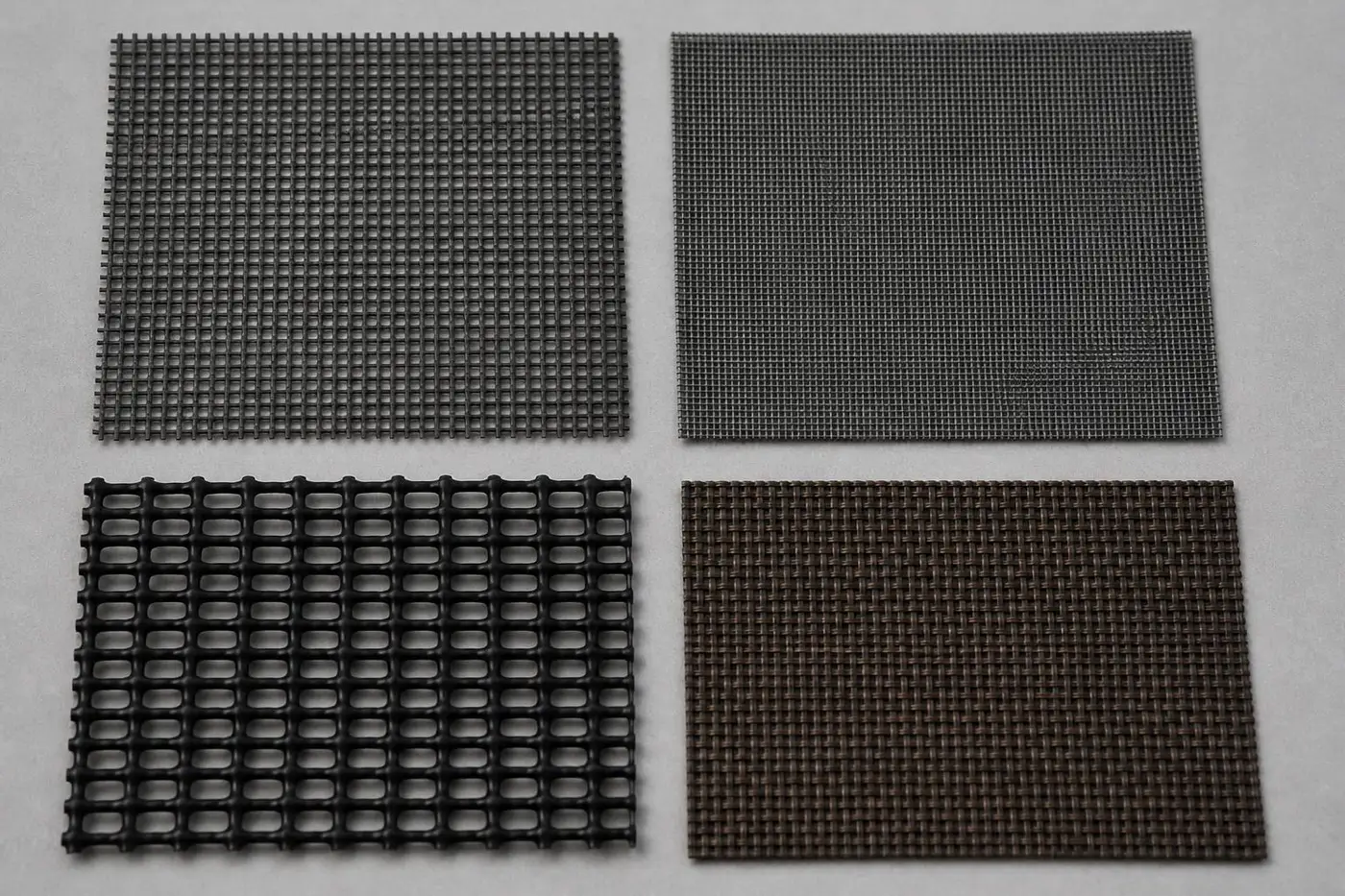
Most Jacksonville enclosures use standard 18/14 fiberglass screen, but the right mesh depends on what is bothering you. No-see-um screen uses a tighter 20/20 weave to keep out the tiny biting insects that come off the marsh and the St. Johns River.
Pet-resistant mesh is a heavier vinyl-coated polyester that stands up to dogs and cats along the lower panels, and solar or privacy screen cuts west-facing afternoon heat and glare. We often mix materials on one cage — pet mesh low, standard or solar up high.
Jacksonville Screen Repair Guide
Why screens fail in a North Florida climate
Jacksonville's mix of intense UV exposure, high humidity, salt-tinged air near the river and coast, and long pollen seasons puts steady stress on screen enclosures that homeowners in drier climates rarely deal with. Fiberglass and aluminum mesh, spline, and the aluminum framing that holds it all together each age differently, and knowing which failure pattern you're looking at is the first step to a sensible repair plan.
UV breakdown makes fiberglass mesh brittle over several years, so panels that once flexed under a light push start to crack or blow out at the corners first. Spline, the thin rubber cord that locks mesh into the frame's groove, hardens and shrinks with heat cycling, which is why a screen can look intact but pop loose from the track after a summer of afternoon storms. Aluminum framing generally holds up well structurally, but fasteners, corner keys, and door hardware corrode or loosen from repeated humidity and temperature swings, especially in enclosures near sprinklers or low-lying yards that stay damp.
UV and heat
Constant sun exposure dries out mesh fibers and spline rubber, leading to brittleness long before the frame itself shows wear.
Humidity and moisture
Persistent dampness promotes mildew and algae staining on screens and tracks, and it accelerates corrosion on fasteners and hinges.
Pollen and organic buildup
Heavy spring pollen coats mesh and settles into door tracks, adding weight and grit that wears spline grooves over time.
Storm cycles
Wind-driven debris and pressure changes during tropical weather stress panels and doors, often finding whatever section was already weak.
Repair or replace: how to decide
Most enclosure problems are isolated to a panel, a section of spline, or a single door, and repairing just that area is usually the more practical route. A full re-screen of the enclosure makes more sense when mesh across multiple panels is uniformly brittle, when patch repairs keep reopening in the same spots, or when the enclosure hasn't been rescreened in many years and one panel failing is a sign the rest are close behind.
Framing tells its own story. Bent or bowed aluminum members, corroded corner keys, or a frame that has visibly shifted point toward a scope that goes beyond screen replacement and into structural work, which a screen-focused repair visit should flag rather than attempt to patch over. A straightforward way to think about it: isolated tears and loose spline are repair jobs; widespread brittleness, repeated failures in the same panel, or frame movement are signals to plan a larger project.
Choosing the right mesh for how you use the space
Standard fiberglass mesh is the most common choice for pool cages and patio enclosures because it balances airflow, visibility, and cost well for general use. Pet-resistant mesh uses a heavier vinyl-coated weave that stands up to claws and nose-pressing far better than standard fiberglass, which matters if dogs or cats spend time in the enclosure. No-see-um mesh has a tighter weave that blocks the tiny biting insects common near marshes and waterways in the area, at some cost to airflow and view clarity. Solar or shade screens cut glare and heat gain on west-facing panels, which can make a real difference on enclosures that get direct afternoon sun.
Standard fiberglass
Good general-purpose mesh with solid airflow and visibility, suited to most patio and pool enclosures.
Pet-resistant mesh
Heavier vinyl-coated strands resist punctures from claws and everyday pet contact at the base of panels.
No-see-um mesh
Finer weave that keeps out small biting insects, useful for properties near wetlands or standing water.
Solar/shade screens
Reduce glare and heat on sun-exposed panels, often used on west- or south-facing sections.
A realistic maintenance calendar
Spreading a few simple checks across the year catches small issues before they turn into full panel failures. After spring pollen season, rinsing mesh and vacuuming door tracks removes grit that otherwise works into spline grooves. Before hurricane season begins, a walk-around to check for loose panels, sagging screens, and door hardware that doesn't latch cleanly is worth the half hour it takes. After any major storm, a visual check for torn panels, bent framing, or debris lodged in tracks helps you catch damage while it's still a repair rather than a replacement.
Twice a year is generally enough for most enclosures; homes near the coast or under heavy tree cover may benefit from checking mesh condition and door hardware a bit more often given faster salt exposure or leaf and pollen buildup.
Storm season and enclosure prep
Tropical weather in the region tends to expose whatever was already marginal in an enclosure, so pre-season attention to loose spline, sagging panels, and door alignment pays off. It's also worth clearing patio furniture, planters, and loose decor from inside the enclosure before storms arrive, since wind can turn those into projectiles against the mesh from the inside. After a storm passes, prioritize a walk-around before assuming everything is fine, since torn panels and loose framing aren't always obvious from a distance.
What to expect from a service-area repair company
Screen Enclosure Repair Jacksonville operates as a mobile, service-area business rather than a storefront with a showroom, which means crews travel to the property rather than customers visiting an office. That model works well for screen repair specifically, since the work happens on-site at the enclosure and there's little benefit to a retail location. Expect a conversation about the damage, a look at photos or an on-site assessment, a general planning range for the work involved, and scheduling that accounts for weather, since screen work isn't done in active rain or high wind.
FAQ
Common Screen Repair Questions
Yes — a single screen panel can be replaced on its own. A technician cuts out the damaged mesh, clears the old spline from the frame channel, and installs new screen in that opening only. Single-panel repair makes sense when the surrounding mesh is still taut and intact; widespread brittleness or repeated tears usually points toward rescreening instead.
Yes. Pool screen and pool enclosure repair are core services. Common problems include torn panels, loose mesh, damaged spline, door issues, and multiple worn sections around a pool cage.
A pool cage needs rescreening when the mesh fails in several places rather than one. Common signs: panels that tear again soon after repair, screen that is brittle or faded, mesh sagging away from the frame, and spline lifting in multiple bays. When damage is limited to one or two panels, targeted panel replacement is usually the more economical fix.
We can assess screen-related damage after wind and storms, including ripped mesh and panels that have pulled loose. Structural damage may require a different type of contractor depending on the condition and scope.
Yes. We repair screened lanais and patios, including individual panels and screen doors. The goal is to restore the screened space without replacing unaffected sections unnecessarily.
Yes. Screen enclosure door repair typically covers torn door screen, worn spline, sagging or out-of-square door frames, and hardware such as hinges, closers, latches, and rollers. Many doors that stick or will not latch are corrected by re-squaring the frame and adjusting hardware rather than replacing the whole door.
Both. We repair and rescreen existing enclosures, and we design and install new ones. New screen enclosures, pool cages, and screened rooms are built to Florida wind-load requirements. Building new is the usual path when a frame is corroded or storm-damaged beyond repair, or when starting from a bare patio, pool deck, or lanai slab.
Screen enclosure repair cost depends on six main factors: the number of panels being replaced, panel size and enclosure height, the screen material chosen, whether door or hardware work is included, site access around the enclosure, and whether the job is a targeted repair or a full rescreen. An on-site assessment defines the exact scope.
A general-purpose check twice a year, plus a look after any major storm, catches most developing problems. Enclosures near the coast or under heavy tree cover may benefit from more frequent checks due to faster salt exposure or debris buildup.
Yes. UV exposure makes fiberglass mesh brittle from the inside out, so it can look intact until a light impact or wind gust causes it to tear. That's why age and sun exposure matter as much as visible condition when deciding whether to repair a panel.
Spline repair re-secures mesh that has come loose from the frame track and is a quicker, lower-cost fix when the mesh itself is still in good shape. A full panel replacement is needed when the mesh is torn, brittle, or has multiple failure points that patching won't reliably solve.
It can, especially if all the mesh was installed at the same time and has had similar sun exposure. One panel failing is often a useful early warning that the rest are approaching the same age-related brittleness, even if they haven't torn yet.
Yes. Standard fiberglass mesh can tear fairly easily from claws or persistent nose-pressing, while pet-resistant mesh uses a heavier vinyl-coated weave built to handle that kind of everyday contact better.
A pre-season check is a good idea so loose panels or hardware issues get addressed before storms arrive, and post-storm inspections help catch new damage early. Active storms themselves are not a safe or practical time for screen work.
Assessments are typically done from photos and a description of the damage, or with an on-site visit, and planning ranges are discussed based on scope rather than a walk-in showroom quote. Scheduling is then coordinated directly for the repair visit.
Small, isolated tears in an accessible panel can sometimes be patched by a confident DIYer with the right mesh and spline roller, but matching mesh type, keeping tension even, and working on elevated pool cage panels safely are common sticking points that lead many homeowners to call in a repair visit instead.
Spline hardening and shrinking with heat cycling is the most common cause, since it gradually loses its grip on the mesh even when the mesh itself is undamaged. Re-splining the affected section usually restores proper tension without needing new mesh.
Ready to get torn or worn screens off your list? Describe the enclosure and the damage, and we will help you plan the next step.
Request an estimate