
Refresh your pool enclosure
Pool Screen & Pool Cage Screen Replacement in Jacksonville, FL
Pool cage screens wear fast in Florida sun — we rescreen panels to match your enclosure.
Pool cage screen takes more abuse than almost any other screen on a Jacksonville property. It sits low over standing water, gets direct sun for most of the day, and catches wind gusts off the pool deck that a shaded porch screen never sees. Pool screen replacement Jacksonville homeowners request ranges from a couple of blown-out panels to pool cage screen replacement across the whole structure, and rescreening pool enclosures completely only makes sense once the mesh is worn everywhere rather than in one spot.
By the time a pool enclosure needs rescreening, homeowners are usually dealing with a mix of sagging panels, sun-bleached mesh that's gone stiff, and a few spots where debris or a pool tool punched through. We handle full pool cage rescreens as well as targeted panel-by-panel replacement.
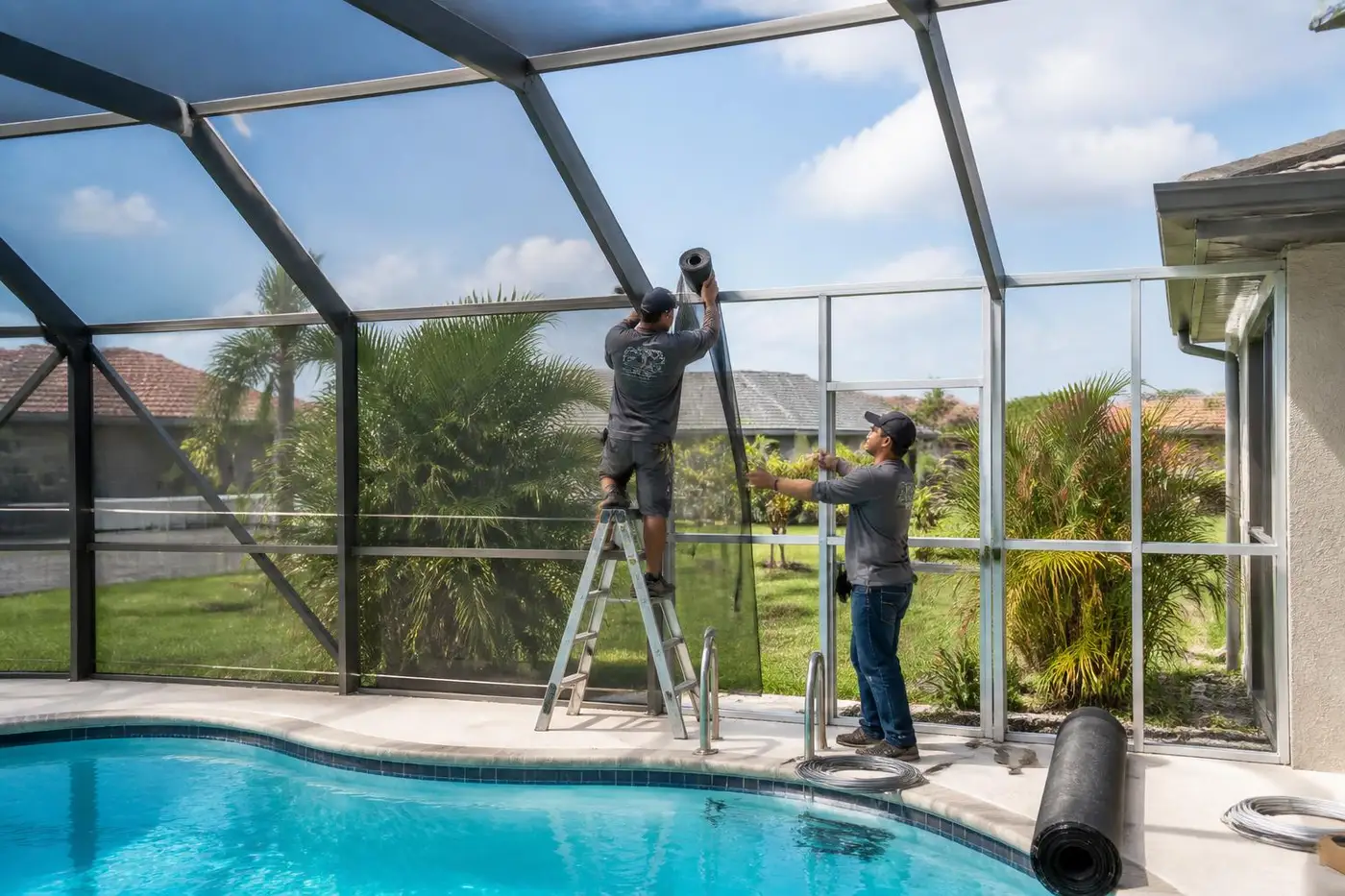
What Pool Screen Replacement Covers
This is the process of removing worn mesh from the aluminum panels of a pool cage — walls and sometimes the roof panels too — and installing new screen with fresh spline. Pool cages often have taller panels and curved eave sections that take more care to keep the mesh tensioned evenly than a flat porch screen.
Why Pool Cages Need This So Often in Jacksonville
UV bouncing off pool water essentially doubles the sun exposure on cage screen compared to shaded areas of the house. Combine that with humidity, chlorine mist, and, for coastal properties, salt air, and pool screen mesh tends to degrade noticeably faster than screen on a standalone lanai.
Signs Your Pool Cage Needs Rescreening
Look for mesh that's gone brittle and crumbles at the edges, panels sagging enough to collect leaves or rainwater, tears from lawn equipment or storm debris, and screws or spline pulling loose from the track. If several panels show these issues at once, it's usually time for a full rescreen rather than one-off patches.
Brittle mesh
Screen that cracks or crumbles when flexed has lost its UV protection and needs replacing.
Sagging panels
Loose tension lets debris and standing water collect on top of screen sections.
Frame corrosion
Check aluminum near the pool deck for pitting, which affects how well new spline seats.
Repair vs. Full Replacement Around a Pool
A single torn panel from a stray branch can often be rescreened on its own. But when sun damage is spread across the whole cage, doing one rescreen pass on every panel at once saves on repeat service calls and keeps the mesh looking uniform, which matters more visually on a pool cage than almost anywhere else on the house.
Panel Replacement vs. Full Pool Cage Rescreening
The dividing line is how widespread the wear is. One or a few damaged panels in otherwise sound mesh is a targeted job — see screen panel replacement for how individual panels are cut, splined, and matched to the surrounding screen.
Widespread worn, brittle, or faded mesh is different. Once panels start failing in several places in the same season, replacing them one at a time costs more over time than doing the structure at once, which is what pool cage rescreening covers. We will tell you honestly which side of that line your cage is on.
Mesh Choices for Pool Enclosures
Standard fiberglass is common and cost-effective, but a lot of Jacksonville pool owners upgrade to heavier or solar-rated mesh on the sections that take the most direct afternoon sun, trading a bit of airflow for a longer stretch before the next rescreen.
The Rescreen Process for a Pool Cage
We inspect the frame and spline channels first, since pool cage aluminum near the deck can corrode from splash and chemicals. Then we remove old screen, replace worn spline, install and tension new mesh panel by panel, and check door and gate panels separately since they see more daily wear.
Weather and Cost Planning
Wind load during hurricane season, direct sun angle, and salt exposure all factor into how often a given pool cage needs rescreening. Budget depends on the number of panels, cage height, and whether you're upgrading mesh type, with taller two-story cages taking more labor to access safely.
When Pool-Side Panels Come Out
Panels over and around a pool age faster than the rest of the enclosure, so they often need replacing while patio-side mesh is still fine. Replace them when the material has gone chalky and stiff, when you can see fine splitting along the spline, when a panel stays bowed after wind, or when leaf and insect intrusion into the water has become a daily maintenance problem.
It's a targeted service - you're not obligated to rescreen the entire structure. Many Jacksonville homeowners do the pool-facing and sun-facing runs first and leave shaded bays for a later visit, which is a reasonable way to spread the cost when only part of the cage has failed.
Materials and Pool-Specific Wear
Pool screen deals with conditions the rest of the enclosure doesn't: UV reflected up off the water onto the underside of the mesh, chlorinated splash and chemical vapor at the lower panels, and constant humidity in the enclosed air volume. Standard 18x14 fiberglass handles it acceptably; heavier-denier pool mesh and pet-grade polyester hold tension better on the tall panels that catch the most wind.
The specific defects: bottom-edge deterioration where splash concentrates, underside fading that shows as a two-tone panel, spline shrinkage that lets a corner lift, and the small punctures near deck level that let frogs into the water. We replace spline on every panel and check the channel for chemical residue before the new mesh goes in.
Cost Factors Around a Pool
Pool panels are usually the largest and tallest on the structure, so per-panel cost runs above a patio bay. Access is the other multiplier - panels over the water require staging that panels over a deck don't, and that shows up in labor.
Mesh selection has real impact here because pool panels are big: upgrading grade across ten large panels costs meaningfully more than the same upgrade on small bays. Replacing all pool-side panels in one visit is the efficient route, since setup over the water is the fixed cost and doing it twice doubles it.
Keep Reading
Related services to compare
When repair is done: Pool Cage Replacement
Full replacements and rebuilds when an aging or storm-damaged enclosure is past practical repair.
Pool Enclosure Replacement explained
Full replacements and rebuilds when an aging or storm-damaged enclosure is past practical repair.
Full rebuild: Storm Damaged Pool Cage Replacement
Full replacements and rebuilds when an aging or storm-damaged enclosure is past practical repair.
Extend its life with Pool Cage Door Replacement
Doors, reinforcement, fasteners, painting, and restoration work that extends an enclosure's usable life.
Pool Cage Screw Replacement details
Doors, reinforcement, fasteners, painting, and restoration work that extends an enclosure's usable life.
Rescreen route: Heavy Duty Pool Screen Replacement
Fresh mesh across a panel, a wall, or an entire pool cage, with the screen type matched to how you use the space.
Local Coverage
Pool Screen Replacement across the Jacksonville area
Pool Screen Replacement in St. Johns
Pool Screen Replacement in Fruit Cove
Pool Screen Replacement in Julington Creek
Pool Screen Replacement in Mandarin
Pool Screen Replacement in Ponte Vedra Beach
Pool Screen Replacement in Nocatee
Pool Screen Replacement in Jacksonville Beach
Pool Screen Replacement in Orange Park
Pool Screen Replacement in St. Augustine
Pool Screen Replacement in Atlantic Beach
Pool Screen Replacement in Neptune Beach
Pool Screen Replacement in World Golf Village
Pool Screen Replacement in Green Cove Springs
Pool Screen Replacement in Middleburg
Pool Screen Replacement in Fleming Island
Pool Screen Replacement in Rivertown
FAQ
Pool Screen Replacement questions
How often do pool cage screens need replacing in Jacksonville?+
Many pool cages need rescreening every 7-10 years, sometimes sooner on sun-heavy or coastal properties.
Can you rescreen just the roof panels?+
Yes, we can rescreen roof panels separately from the walls if that's where the wear is concentrated.
Does pool chemical exposure affect mesh lifespan?+
Chlorine mist and humidity near a pool can accelerate wear on fiberglass mesh compared to screen elsewhere on the property.
Should I rescreen before or after resurfacing the pool deck?+
It's usually easier to schedule rescreening after major deck work is finished to avoid dust or debris settling on new screen.
Do you replace the door screen on a pool cage too?+
Yes, cage access doors and gates get rescreened along with the wall panels since they see frequent use.
Request a free estimate and we'll inspect your pool cage panel by panel before recommending a rescreen plan.
Request an estimate