Stronger mesh for tougher conditions
Heavy-Duty Pool Screen Replacement in Jacksonville, FL
Heavier gauge mesh for pool cages facing storms, sun, or heavy use.
Some pool cages need more than standard fiberglass screen can offer. Whether it's a cage that catches direct wind off open water, one that's exposed to heavy sun most of the day, or a household with active kids and pets around the pool, heavier-gauge mesh holds up longer than the standard weave most enclosures come with.
Heavy-duty pool screen replacement swaps standard 18x14 fiberglass for a thicker, more tear-resistant mesh — often aluminum or a reinforced fiberglass weave — built to handle more physical stress before it needs replacing again.
What Counts as Heavy-Duty Mesh
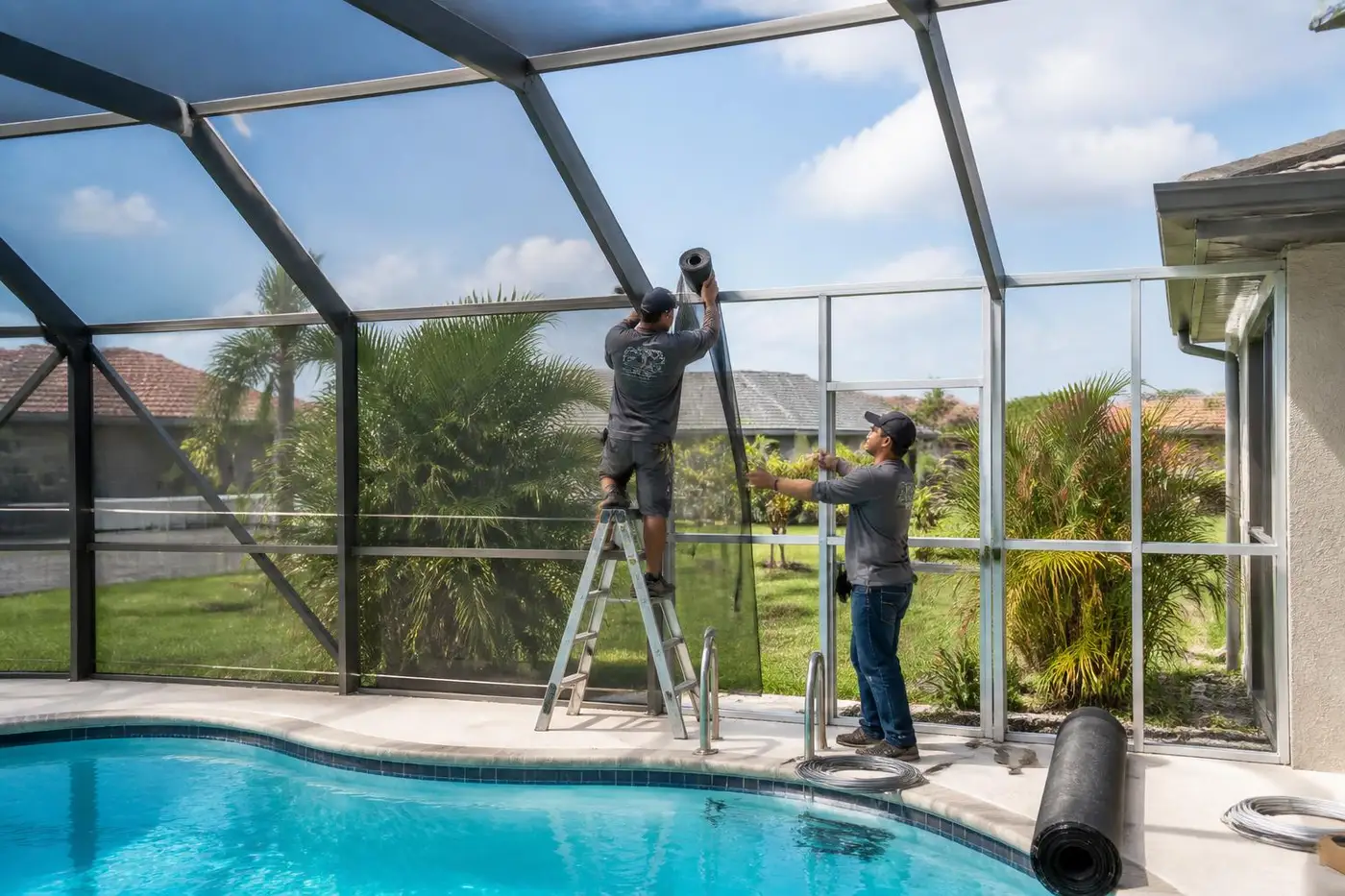
Heavy-duty options include thicker-gauge fiberglass, aluminum screen, and reinforced weaves designed to resist tearing and impact better than standard mesh. These materials are stiffer and often a bit more visible in the weave than standard fiberglass, but they trade a small amount of clarity for meaningfully longer service life.
Why Some Jacksonville Pool Cages Need It
Cages on open lots without much wind break, properties near the coast dealing with salt air, and households with kids or pets constantly in and out of the pool area all put more stress on screen than average. Standard mesh can handle normal use fine, but these conditions wear it out faster than expected.
Heavy-Duty vs. Standard Mesh Trade-Offs
Aluminum and reinforced mesh cost more per panel and can be a little more labor-intensive to install because they don't flex as easily around curved eave sections. In exchange, they resist punctures from debris, hold their tension better over time, and generally outlast standard fiberglass in high-stress spots.
Aluminum mesh
Rigid, tear-resistant, holds tension well, but can oxidize near saltwater over time.
Reinforced fiberglass
Thicker weave than standard, better impact resistance, moderate cost increase.
Installation
Stiffer material takes more care around curved cage sections and corners.
Longevity
Generally outlasts standard mesh in high-wind or high-traffic pool areas.
Repair vs. Full Replacement
If only the panels facing prevailing wind or the pool deck's high-traffic side are worn, we can upgrade just those to heavy-duty mesh while leaving the rest standard. When the whole cage shows wear from age or a major storm, a full replacement with heavier mesh throughout makes more sense.
Installation Process
We start by checking the frame and spline channels, since heavier mesh puts more stress on aging aluminum and worn spline. From there we remove the old screen, replace spline as needed, and install the new mesh panel by panel, tensioning carefully given the stiffer material.
Storm and Sun Considerations
During hurricane season, heavier mesh generally holds up better to wind-driven debris than standard screen, though no screen mesh is rated to stop major storm impact the way panel shutters are. Constant sun exposure on pool cages also breaks down mesh fibers faster, which is part of why heavy-duty options make sense on south- and west-facing cages.
Cost Planning
Expect heavy-duty mesh to run higher per panel than standard fiberglass, with total cost depending on how many panels you upgrade, cage height, and whether curved sections add installation time. Many homeowners target just the wind- or sun-exposed panels first to manage cost while addressing the biggest wear points.
When Standard Mesh Isn't Enough
Heavy-duty mesh is for cages that keep losing panels. If the same bays blow out after every storm season, if your enclosure has spans wide enough that panels visibly balloon in ordinary wind, or if you're on an open lot or near the water with no windbreak, standard 18x14 is being asked to do more than it's rated for.
It's also the sensible spec when re-screening after storm damage - replacing failed standard mesh with the same standard mesh in the same exposed bays is a repeat visit waiting to happen. On sheltered, shorter-span enclosures the upgrade is unnecessary and standard mesh will serve fine.
Heavier Mesh Grades and Wind Behavior
Heavy-duty pool screen uses a higher-denier fiberglass or a reinforced polyester, giving greater tensile strength and better tension retention across long spans than the standard weave. The practical effect is less deflection under gusts, which matters because a ballooning panel pulls on the spline and on the frame itself.
What it addresses: panels tearing free at the spline under uplift, permanent bowing after a storm, and the frame stress that repeated panel movement causes at knuckles and uprights. It slightly reduces airflow and visibility compared with 18x14. It is not a hurricane rating - in a named storm the correct approach is still to accept that panels are the designed sacrificial element, and reinforcement of the frame matters more than mesh grade.
Cost Versus Repeat Repairs
Heavy-duty mesh runs above standard per square foot and is stiffer to install, so both material and labor rise. On the large panels typical of a pool cage that adds up quickly, which is why it's usually specified selectively.
The honest math: if a set of bays has cost you a service call after each of the last two storm seasons, upgrading those bays is cheaper over three years than continuing to replace standard mesh. If your enclosure has never lost a panel, the premium buys peace of mind rather than savings. We'll tell you which bays actually take the load rather than upgrading the whole cage by default.
Keep Reading
Related services to compare
When repair is done: Pool Cage Replacement
Full replacements and rebuilds when an aging or storm-damaged enclosure is past practical repair.
Pool Enclosure Replacement explained
Full replacements and rebuilds when an aging or storm-damaged enclosure is past practical repair.
Full rebuild: Storm Damaged Pool Cage Replacement
Full replacements and rebuilds when an aging or storm-damaged enclosure is past practical repair.
Extend its life with Pool Cage Door Replacement
Doors, reinforcement, fasteners, painting, and restoration work that extends an enclosure's usable life.
Pool Cage Screw Replacement details
Doors, reinforcement, fasteners, painting, and restoration work that extends an enclosure's usable life.
Rescreen route: Pool Screen Replacement
Fresh mesh across a panel, a wall, or an entire pool cage, with the screen type matched to how you use the space.
Local Coverage
Heavy Duty Pool Screen Replacement across the Jacksonville area
Heavy Duty Pool Screen Replacement in St. Johns
Heavy Duty Pool Screen Replacement in Fruit Cove
Heavy Duty Pool Screen Replacement in Julington Creek
Heavy Duty Pool Screen Replacement in Mandarin
Heavy Duty Pool Screen Replacement in Ponte Vedra Beach
Heavy Duty Pool Screen Replacement in Nocatee
Heavy Duty Pool Screen Replacement in Jacksonville Beach
Heavy Duty Pool Screen Replacement in Orange Park
Heavy Duty Pool Screen Replacement in St. Augustine
Heavy Duty Pool Screen Replacement in Atlantic Beach
Heavy Duty Pool Screen Replacement in Neptune Beach
Heavy Duty Pool Screen Replacement in World Golf Village
Heavy Duty Pool Screen Replacement in Green Cove Springs
Heavy Duty Pool Screen Replacement in Middleburg
Heavy Duty Pool Screen Replacement in Fleming Island
Heavy Duty Pool Screen Replacement in Rivertown
FAQ
Heavy Duty Pool Screen Replacement questions
Is heavy-duty mesh worth it for every pool cage?+
Not necessarily — it makes the most sense for cages facing heavy wind, direct sun, or high traffic; standard mesh is fine for many homes.
Does heavy-duty screen stop storm debris completely?+
It resists punctures better than standard mesh but isn't a substitute for shutters during a major storm.
Can I upgrade just part of my pool cage?+
Yes, we often install heavy-duty mesh only on the panels facing prevailing wind or heaviest sun, keeping the rest standard.
Does aluminum mesh rust near the coast?+
It can oxidize over time in salt air, though it generally still outlasts standard fiberglass in most conditions.
How much more does heavy-duty mesh cost than standard?+
It runs higher per panel than standard fiberglass; total cost depends on how many panels you choose to upgrade.
Call for a free estimate and we'll identify which panels would benefit most from heavy-duty mesh.
Request an estimate