Screen out the sightlines
Privacy Screen Installation in Jacksonville, FL
Solar and privacy mesh cut visibility and glare without giving up your outdoor space.
Standard screen keeps bugs out, but it doesn't do much to block sightlines from neighbors, the street, or an upper-floor window next door. Privacy screen mesh addresses that directly, using a darker, tighter weave that limits how much can be seen through the panel from the outside while still letting you see out.
It's a common upgrade on Jacksonville lanais and pool cages in closer-set neighborhoods, corner lots, or homes backing up to a busy street, where standard fiberglass leaves the enclosure feeling more exposed than homeowners want.
What Privacy Screen Is
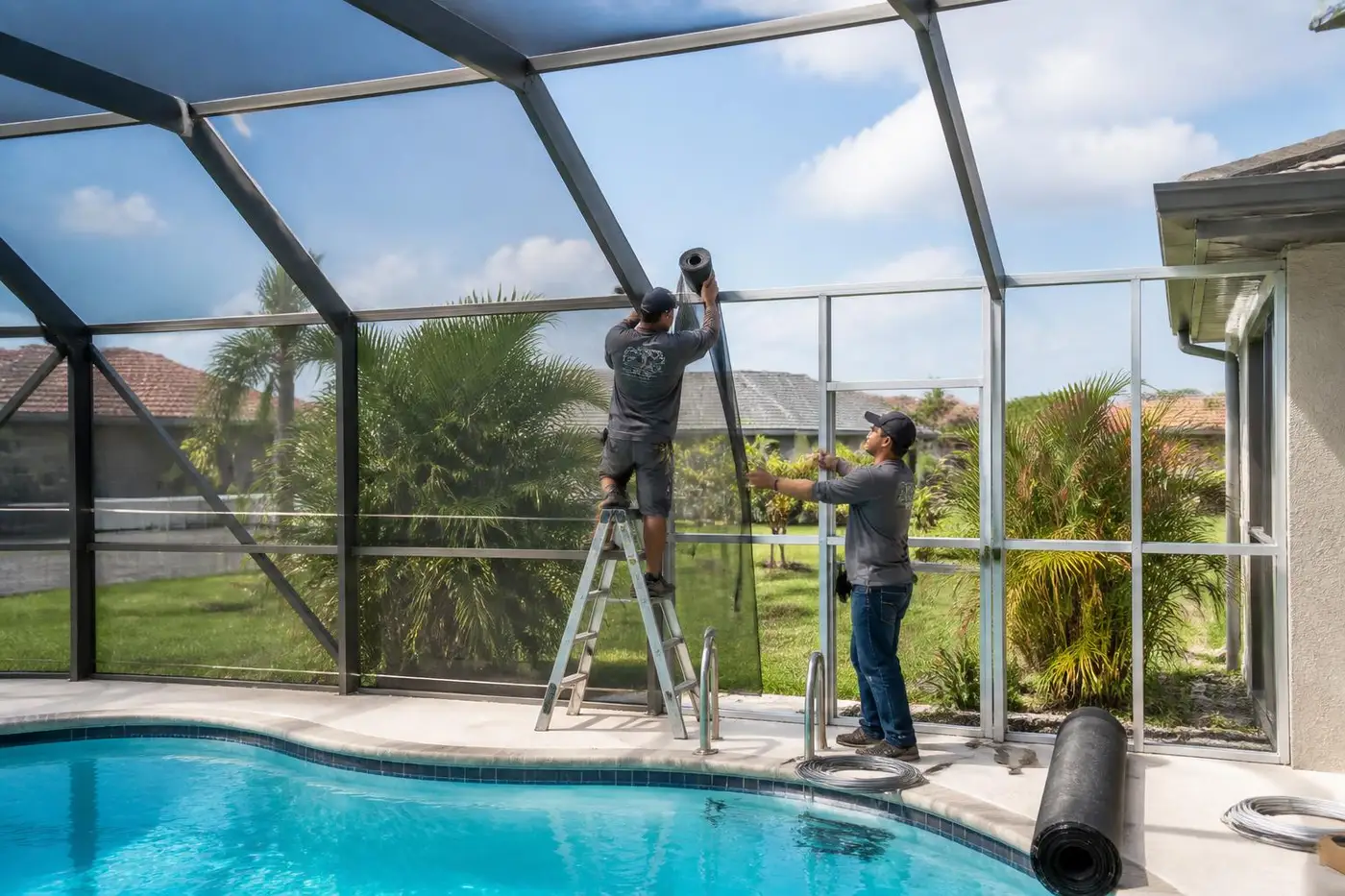
Privacy and solar mesh are typically vinyl-coated polyester weaves in darker colors like charcoal or black, woven tightly enough to significantly cut visibility from the outside while remaining fairly see-through from inside the enclosure. The tighter weave also blocks a meaningful amount of solar heat and glare.
Why Jacksonville Homeowners Choose It
Pool cages especially benefit, since a pool is often the most exposed part of a backyard. Homes on smaller lots, corner properties, or those near multi-story neighboring houses use privacy mesh to keep the pool and lanai feeling more enclosed without building a solid wall or fence extension.
Visibility and Airflow Trade-Offs
The tighter, darker weave that blocks outside sightlines also reduces airflow more than standard screen, and it can make the enclosure feel slightly warmer on still days since it's also cutting some direct sun. Most homeowners install it on the sides facing neighbors or the street, keeping standard mesh on sides that already have privacy from trees or fencing.
Outside visibility
Darker, tight weave significantly reduces what's visible from outside the enclosure.
Inside visibility
You can generally still see out reasonably well, though it's dimmer than standard screen.
Airflow
Noticeably less breeze passes through compared to standard 18x14 mesh.
Heat and glare
Blocks a good amount of direct sun, which can make shaded areas feel cooler.
Partial vs. Full Installation
Most homeowners don't need privacy mesh on every panel. We commonly install it only on the sides facing neighbors, the street, or a pool deck, while keeping standard screen on sides that back up to woods, water, or a fence line where privacy isn't a concern.
Installation Process
Installation follows the standard rescreen steps — checking frame and spline condition, removing old mesh, then cutting and tensioning the new panels. Because privacy mesh is heavier and stiffer than standard screen, we take extra care getting even tension so it doesn't sag or pucker at the corners.
Weather Considerations
In Jacksonville's humid summers, reduced airflow from privacy mesh is more noticeable on still, muggy days than on breezy ones. During hurricane season, the heavier material needs to be tensioned properly to handle wind load, similar to other specialty mesh types, and salt air near the coast will gradually fade darker-colored mesh over time.
Cost Planning
Privacy and solar mesh cost more per panel than standard fiberglass, so most homeowners target the specific panels where privacy matters most rather than upgrading the whole enclosure. Total cost depends on square footage of the panels selected, cage height, and any curved sections that take more time to fit.
When Privacy Mesh Is the Right Answer
Privacy screen makes sense when the issue is sightlines or sun rather than insects - a neighbor's second-story window overlooking the pool, a cage that fronts a road or sidewalk, or a west-facing lanai that becomes unusable from four o'clock on.
It's typically installed on specific runs rather than the whole enclosure, since blocking every side leaves the space dark and closed-in. If your goal is only shade, a solar weave on the sun side may serve better than a true privacy weave; if the goal is genuinely not being seen, the denser material is what does it.
Weave Densities, Colors, and Effect
Privacy and solar meshes come in graded densities, commonly described by the percentage of light they block. Lower densities cut glare and heat while keeping a usable view out. Higher densities give real visual screening from outside during the day, at the cost of view and airflow from inside.
Color matters as much as density: darker weaves preserve outward visibility better while appearing more opaque from outside, lighter ones bounce more heat but wash out the view. All of these are one-way in daylight only - after dark with lights on inside, the effect reverses, which is the single most common misunderstanding about this product. The material installs in the standard spline channel like any other mesh.
Pricing a Partial Privacy Install
Privacy and solar weaves are priced above standard mesh per square foot, with denser and better-warranted materials at the top of the range. Because most installs cover only one or two runs, the total often lands close to a standard rescreen of the same area rather than far above it.
Cost drivers are the panel area covered, the density chosen, and whether the work happens during a full rescreen or as a standalone visit. Combining it with a scheduled rescreen is notably cheaper, and it lets you match spline and finish across the whole enclosure in one pass.
Keep Reading
Related services to compare
Build new: Screen Enclosure Installation
New pool cages, pool enclosures, lanais, screened patios, screen rooms, and custom aluminum structures.
Pool Cage Installation for Jacksonville homes
New pool cages, pool enclosures, lanais, screened patios, screen rooms, and custom aluminum structures.
Planning Pool Enclosure Installation
New pool cages, pool enclosures, lanais, screened patios, screen rooms, and custom aluminum structures.
Extend its life with Screen Enclosure Door Installation
Doors, reinforcement, fasteners, painting, and restoration work that extends an enclosure's usable life.
No-See-Um Screen Installation for worn screen
Fresh mesh across a panel, a wall, or an entire pool cage, with the screen type matched to how you use the space.
Rescreen route: Pet Resistant Screen Installation
Fresh mesh across a panel, a wall, or an entire pool cage, with the screen type matched to how you use the space.
Local Coverage
Privacy Screen Installation across the Jacksonville area
Privacy Screen Installation in St. Johns
Privacy Screen Installation in Fruit Cove
Privacy Screen Installation in Julington Creek
Privacy Screen Installation in Mandarin
Privacy Screen Installation in Ponte Vedra Beach
Privacy Screen Installation in Nocatee
Privacy Screen Installation in Jacksonville Beach
Privacy Screen Installation in Orange Park
Privacy Screen Installation in St. Augustine
Privacy Screen Installation in Atlantic Beach
Privacy Screen Installation in Neptune Beach
Privacy Screen Installation in World Golf Village
Privacy Screen Installation in Green Cove Springs
Privacy Screen Installation in Middleburg
Privacy Screen Installation in Fleming Island
Privacy Screen Installation in Rivertown
FAQ
Privacy Screen Installation questions
Can people still see in at all with privacy mesh?+
It significantly reduces visibility from outside but isn't completely opaque, especially at close range or in direct light.
Does privacy screen block the pool view from inside?+
You can generally still see out reasonably well from inside the enclosure, though it's dimmer than standard screen.
Do I need it on the whole enclosure or just certain panels?+
Most homeowners only need it on the sides facing neighbors, the street, or the pool deck, keeping standard mesh elsewhere.
Will privacy mesh make the lanai hotter?+
It actually blocks some direct sun and glare, though reduced airflow can make still days feel warmer.
Does dark mesh fade in Florida sun?+
Darker colors will fade gradually over years of sun and salt air exposure, similar to other specialty mesh types.
Call for a free estimate and we'll help you decide which panels need privacy mesh and which don't.
Request an estimate