
Mesh and spline specialists
Pool Cage Screen Repair in Jacksonville, FL
Focused repair of the screen and spline on your pool cage, not the aluminum frame underneath.
Pool cage screen repair deals with the mesh itself: the panels stretched across your cage's aluminum frame, the spline that locks each panel into its channel, and the tension that keeps a panel flat instead of billowing or sagging. This is different from structural pool cage repair, which looks at bent framing, corroded gutters, and anchoring - here the frame can be perfectly sound while the screen on top of it has still worn out, torn, or blown loose.
In Jacksonville, screen over a pool cage takes a rougher beating than screen almost anywhere else on a property. Reflected sunlight off the pool surface, chlorine or salt system mist drifting upward, and afternoon storm gusts all work on the mesh and spline at once. It's common to see a cage with a solid frame but a patchwork of screen in different ages, colors, and mesh types from years of piecemeal repairs.
We repair pool cage screen for homes across Jacksonville and Northeast Florida, from cages with a single blown panel after a storm to cages where most of the mesh needs to come off and be replaced together.
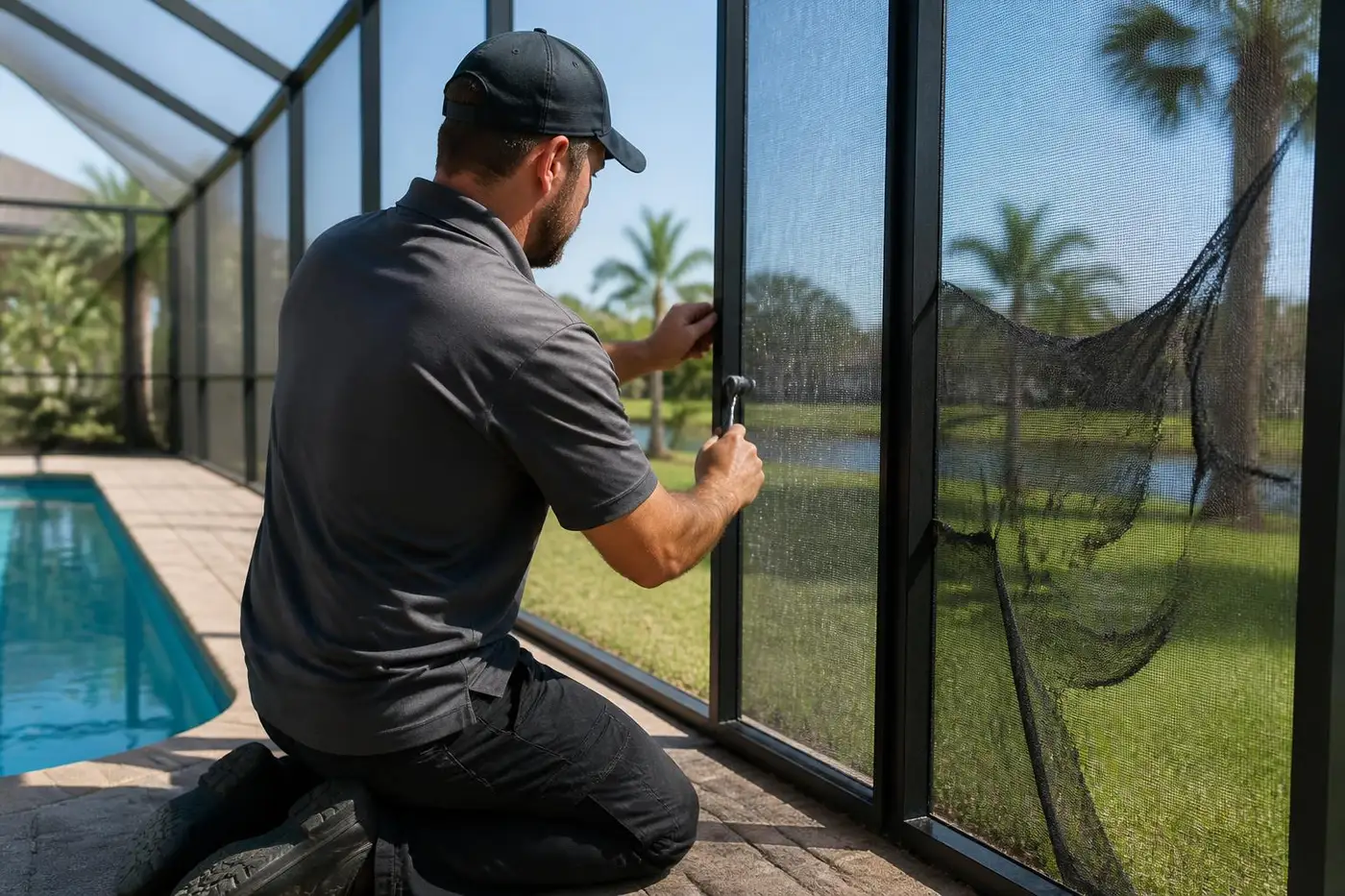
What This Service Covers
This is screen-and-spline work: stripping worn or torn mesh off individual panels, cutting and stretching new mesh across the existing frame, and rolling fresh spline into the channel to lock it in tight. It also covers re-tensioning panels where the mesh is still intact but has gone loose, and swapping out dried, cracked spline even on panels where the screen itself hasn't failed yet.
We don't touch the aluminum extrusion, gutters, or anchoring as part of this service unless something is obviously compromised - if we find bent framing or corroded connectors during the job, we'll point it out separately rather than folding it into a screen repair.
Why Jacksonville Pool Cage Screen Fails So Often
Mesh directly over a pool gets hit with UV from above and reflected UV off the water below, which roughly doubles sun exposure compared to screen on a patio away from the pool. Add in chlorine or saltwater chemical mist settling on the panels day after day, humidity that keeps spline from ever fully drying out, and wind gusts during storm season that flex panels against their frame, and it's clear why pool cage screen is usually the first thing to fail on an otherwise decent enclosure.
Reflected UV
Sunlight bouncing off pool water breaks down mesh fibers from underneath as well as above.
Chemical mist
Chlorine and salt system output settle on screen and spline, speeding up material breakdown.
Wind flex
Storm gusts repeatedly stretch panels against the spline channel until it releases.
Humidity on spline
Constant moisture near the pool keeps spline from drying, making it brittle and slick over time.
Common Screen and Spline Problems We See
Torn or blown-out panels are the most obvious call, usually near doors or corners where wind pressure concentrates. Just as common is spline that's dried, cracked, or worked loose so the mesh sits in the channel but is no longer held tight, leading to sagging or a panel that flaps in wind even though the screen has no holes. We also regularly find roof panels in far worse shape than wall panels, since roof mesh takes direct sun and rain impact that vertical panels are partly shielded from, and cages where a string of past patch jobs left mismatched mesh colors, weaves, and even mesh types scattered across the structure.
Roof Panels vs. Wall Panels
Roof screen and wall screen wear at different rates, and it's worth treating them separately when planning a repair. Roof panels sit flat or nearly flat, so rain and debris settle and pool on them instead of running off the way it does on a vertical wall panel, and they take the brunt of direct overhead sun. It's common for a cage's roof to need a full re-screen years before the walls do, and re-screening only the roof, or only the walls, is a reasonable way to spread out the cost instead of doing the whole cage at once.
Mesh Tension and Why It Matters
A properly re-screened panel should be drum-tight, with no sag when you press on it. Panels installed with too little tension sag, collect rainwater, and stretch out further over time, which loosens the spline faster and shortens the life of the screen. Over-tensioning has its own problems, putting extra stress on the frame corners and spline channel that can lead to early failure at the corners. Getting tension right during installation is one of the biggest factors in how long a re-screened panel actually lasts.
Dealing With Mismatched Mesh From Past Repairs
Cages that have had several rounds of patch repairs over the years often end up with a visible mix of mesh types and colors: standard 18x14 fiberglass next to no-see-um mesh, gray mesh next to charcoal, or different weave densities that catch the light differently. When we re-screen, we try to match the surrounding panels as closely as possible, but if a cage has accumulated enough mismatched patches, a broader re-screen of one section or the whole cage often gives a cleaner, more consistent result than adding yet another mismatched panel.
Mesh Options for Pool Cage Panels
Standard 18x14 fiberglass mesh remains the most common and economical choice for both roof and wall panels. Homeowners bothered by evening no-see-ums near the coast often upgrade to 20x20 no-see-um mesh, which blocks smaller insects but cuts down airflow slightly, something to weigh especially on roof panels. Pet screen is a heavier, tear-resistant option worth considering on lower wall panels where dogs spend time near the pool deck. Solar or privacy mesh cuts glare and blocks sightlines on side panels, though it's less commonly used directly over the water.
How the Repair Process Works
We inspect panel by panel, checking both the mesh condition and the spline, since a panel can look fine from a distance while the spline underneath is already failing. Old screen is pulled from the channel, new mesh is cut oversized and laid across the frame, and a spline roller presses fresh spline into the channel to seat the screen evenly and tight. Excess mesh is trimmed clean at the edge, and we finish by checking that door panels, which see the most flexing, are tensioned and seated correctly.
Cost depends mainly on how many panels need new mesh versus just new spline, whether roof and wall panels are both involved, and which mesh type you choose. Re-splining a panel with sound mesh is a smaller job than a full re-screen. We give a free, in-person estimate after walking the cage panel by panel, so the number reflects your actual mesh condition instead of a phone guess.
Keep Reading
Related services to compare
Fix it first: Pool Cage Repair
Targeted fixes for torn screen, damaged panels, doors, frames, hardware, and storm damage.
Pool Cage Frame Repair in Jacksonville
Targeted fixes for torn screen, damaged panels, doors, frames, hardware, and storm damage.
Rescreen route: Pool Cage Rescreening
Fresh mesh across a panel, a wall, or an entire pool cage, with the screen type matched to how you use the space.
Build new: Pool Cage Installation
New pool cages, pool enclosures, lanais, screened patios, screen rooms, and custom aluminum structures.
Pool Cage Replacement explained
Full replacements and rebuilds when an aging or storm-damaged enclosure is past practical repair.
Repair option: Pool Screen Repair
Targeted fixes for torn screen, damaged panels, doors, frames, hardware, and storm damage.
Local Coverage
Pool Cage Screen Repair across the Jacksonville area
Pool Cage Screen Repair in St. Johns
Pool Cage Screen Repair in Fruit Cove
Pool Cage Screen Repair in Julington Creek
Pool Cage Screen Repair in Mandarin
Pool Cage Screen Repair in Ponte Vedra Beach
Pool Cage Screen Repair in Nocatee
Pool Cage Screen Repair in Jacksonville Beach
Pool Cage Screen Repair in Orange Park
Pool Cage Screen Repair in St. Augustine
Pool Cage Screen Repair in Atlantic Beach
Pool Cage Screen Repair in Neptune Beach
Pool Cage Screen Repair in World Golf Village
Pool Cage Screen Repair in Green Cove Springs
Pool Cage Screen Repair in Middleburg
Pool Cage Screen Repair in Fleming Island
Pool Cage Screen Repair in Rivertown
FAQ
Pool Cage Screen Repair questions
How is pool cage screen repair different from pool cage repair?+
Screen repair focuses only on the mesh panels and spline. Pool cage repair covers the aluminum frame, gutters, and anchoring. Many cages need one but not the other.
Why is my pool cage roof screen worse than the walls?+
Roof panels take direct overhead sun and let rain and debris pool on them, so they generally wear out and need re-screening before the wall panels do.
Can you fix loose spline without replacing the screen?+
Yes, if the mesh itself is still in good shape, we can pull it, install fresh spline, and re-tension the panel without full re-screening.
My cage has mismatched screen from old patches - can you fix that?+
We can match new panels to the surrounding mesh where possible, but if there's already a lot of mismatch, re-screening a full section often gives a cleaner, more even look.
What mesh do you recommend for pool cages near the coast?+
Standard 18x14 fiberglass works for most cages, but many coastal homeowners upgrade to 20x20 no-see-um mesh to cut down on evening insects.
Call (904) 853-3510 for a free estimate on your pool cage screen and spline repair.
Request an estimate