
Attached screen room repairs
Lanai Screen Repair in Jacksonville, FL
Screen and frame repair for lanais so your everyday outdoor space stays bug-free.
Lanai screen repair Jacksonville FL homeowners need usually starts with the space they use most: the screened room attached to the back of the house, just off the living room or kitchen. Because a lanai is used daily, wear shows up fast — a torn panel near a frequently used door, screen stretched loose from being brushed against, or spline working its way out of the track. Screened lanai repair handles those individual failures; lanai rescreening Jacksonville homes eventually need takes over when the mesh is tired everywhere at once.
Lanai screen repair in Jacksonville deals with these everyday wear issues along with the effects of local weather: humidity, pollen, and the wind that comes through even a covered, attached space during storms. Since a lanai is part of the house's living area in a practical sense, we try to work efficiently and keep disruption to a minimum.
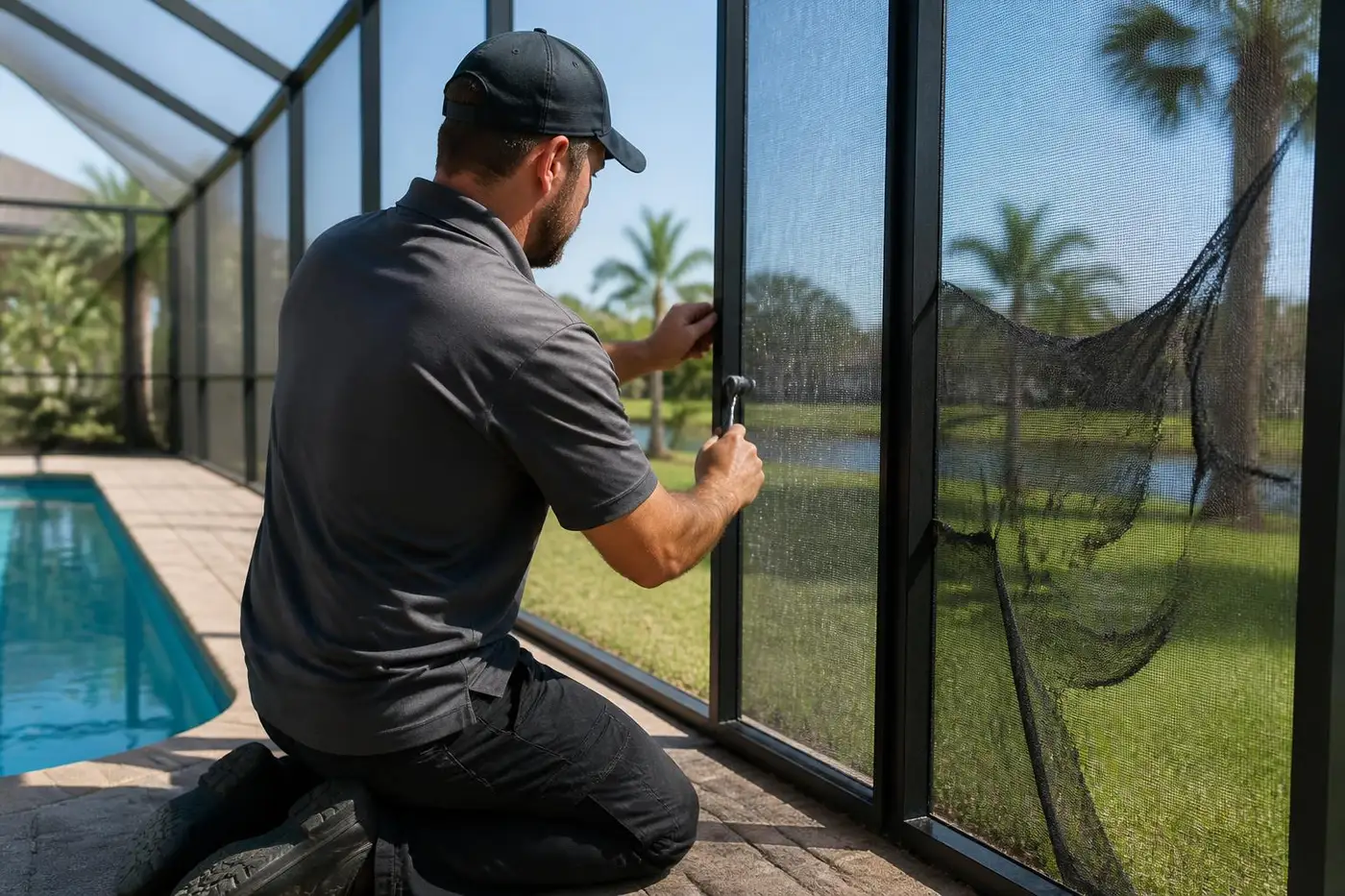
What Lanai Screen Repair Covers
This includes re-screening torn or worn panels, re-spline-ing sections where the screen has come loose from the frame channel, adjusting or repairing screen doors that see heavy daily traffic, and addressing any minor frame issues like loose corner brackets that come from years of door use.
Because lanais are often smaller and more enclosed by the house structure than a full pool cage, repairs can usually be done efficiently in a single visit for most panel and spline issues.
Why Lanais Wear Differently Than Pool Cages
Lanai screens see more foot traffic and daily contact than screens further out over a pool, since people are walking through the doors, brushing past panels, and sometimes leaning on the frame. That daily use, combined with Jacksonville's humidity and UV exposure, tends to wear out door hardware and nearby screen panels faster than the rest of the space. Pets that use the lanai as their main outdoor access point also put more pressure on lower panels than they would on panels further from the house.
Common Problems on a Lanai
The most frequent issues are torn screen right around the main door, sagging or loose panels where spline has dried and released, and door hardware - handles, latches, closers - wearing out from constant daily use. Screens facing west or south that get strong afternoon sun also tend to fade and become brittle faster than shaded panels.
Door-area wear
The most-used panel on a lanai typically shows tears and loose spline first.
Sun-faded panels
West- or south-facing screens see the most UV and often need repair ahead of the rest of the space.
Repair vs. Replacement Considerations
Most lanai issues are straightforward panel and spline repairs since the frame is typically well protected by the house structure on at least one or two sides. Replacement of larger sections becomes worth discussing if the frame shows corrosion at multiple connection points, or if most panels across the lanai are the same age and worn enough that a full re-screen makes more sense than repairing them one at a time over successive seasons.
Lanai Repair vs Full Lanai Rescreening
Screen lanai repair makes sense when the frame is sound and the damage is contained: one or two torn panels, a loose spline run, or a door that has dropped out of square. Those are quick visits, and there is no reason to touch panels that still have life in them.
Full rescreening is the better value once several panels have failed in the same year, the mesh is brittle enough to tear when pressed, or you want a different material throughout. That work is covered on screen enclosure rescreening, and single failures are covered on screen panel replacement.
Two other items often ride along with a lanai job: the door, handled on screen door repair, and a mesh upgrade such as no-see-um screen installation for evenings near the water. If the lanai structure itself is undersized or missing entirely, lanai screen enclosure installation covers building new.
Mesh Options for a Lanai
Standard 18x14 fiberglass mesh is common for lanais and holds up well given the more protected exposure compared to open pool cages. Homeowners who use the lanai for evening dining often choose 20x20 no-see-um mesh to cut down on gnats and small insects. Privacy or solar mesh is a popular option for lanais facing a neighbor's yard or getting strong late-day sun, since it reduces glare and sightlines while keeping the space usable.
The Repair Process
We check each panel and the door assembly, re-screen and re-spline as needed, and adjust or replace worn door hardware. Because a lanai is right off the house, we're careful about keeping work areas clean and finishing efficiently since the space is used daily.
Weather Factors
Even though a lanai is more sheltered than an open pool cage, it still deals with Jacksonville's humidity, pollen buildup each spring, and wind that can gust through during summer storms. Salt air is less of a factor for lanais further from the coast, but still worth considering for repairs closer to the beaches.
Planning for Cost
Because lanais are usually smaller than a full pool cage, repairs tend to be less extensive and more affordable overall. Cost depends mainly on how many panels need re-screening and whether door hardware needs replacing. We give a free estimate on-site so you know the cost before work begins.
Service Guide
Why lanai and patio screens take extra abuse in Jacksonville
A lanai or patio cage sits at the intersection of every weather pattern Northeast Florida throws at a home: intense UV exposure through midday, salt-tinged air if you're near the river or coast, sudden downpours, and long stretches of humidity that never really let materials dry out completely. The screen panels on a lanai are usually larger than a typical door or window screen, which means more surface area for wind to grab during a storm and more spline groove to work loose over time.
Because a lanai is meant to be an outdoor living space, it also gets more foot traffic, more furniture moved across the deck near screen walls, and more contact from kids, pets, and grills than a screened porch that's rarely used. All of that adds up to panels that stretch, sag, or blow out well before a typical replacement schedule would suggest.
Common failure points on screened lanais and patios
Most lanai screen problems fall into a short list of repeatable patterns. Bottom panels near ground level take the brunt of lawn equipment, mulch, and pets, so they tend to tear or pull out of the spline groove first. Panels near doors get more hand contact and are more likely to develop small holes that widen. Top panels on a pool cage are exposed to the most direct sun and often show UV degradation as chalky, brittle mesh even without visible damage.
Spline pull-out
Sun-hardened spline shrinks and loses grip in the aluminum groove, letting panel edges pop free even when the mesh itself is intact.
Panel bow or sag
Mesh stretches over time from wind loading and heat cycling, leaving a visibly loose or rippled panel that no longer sits taut in the frame.
Corner separation
Where two screen walls meet at a post or corner bead, repeated flexing can pull the mesh away from the frame first.
Debris punctures
Falling branches, acorns, and wind-blown yard debris create small punctures that widen quickly in high-tension pool cage screen.
Matching mesh type to how you actually use the space
Standard fiberglass mesh is the common default for lanai screening because it's inexpensive and easy to work with, but it isn't the right call for every household. If pets spend time on the lanai, pet-resistant mesh — a heavier, tightly woven vinyl-coated product — resists claws and noses far better and is worth the added material cost on lower panels even if you keep standard mesh up top.
For lanais used heavily in the evening, no-see-um mesh with its finer weave keeps out the small biting insects that regular screen lets through, though it does reduce airflow slightly. Solar or shade screening is a different consideration altogether: it cuts glare and heat gain on west- and south-facing panels, which matters a lot for a pool cage that bakes in Florida sun most of the day.
Panel-by-panel repair versus rescreening the whole cage
Most lanai screen repair is done panel by panel rather than as a full cage rescreen, and that's usually the more sensible approach financially and practically. If only a handful of panels show tearing, sagging, or spline failure, replacing those individually keeps cost proportional to the actual damage and avoids paying to remove mesh that still has useful life left.
A full rescreen makes more sense when the majority of panels show UV degradation at once — which tends to happen because they were all installed around the same time and have aged together — or when a storm has caused widespread damage across the cage. In planning terms, a handful of panel repairs on a lanai typically lands in a lower range than doing the whole structure, but the total depends heavily on panel count, height, and mesh type, so it's worth getting the space assessed rather than guessing from a per-panel estimate alone.
Framing, doors, and hardware on a lanai cage
The aluminum framing on a lanai cage is generally more durable than the mesh itself, but it isn't maintenance-free. Screws and fasteners at panel corners can back out or corrode over years of thermal expansion and contraction, and loose fasteners let a panel shift, which accelerates spline and mesh wear at that spot. Kickplates and chair rails at the base of screen walls protect the lower mesh from lawn equipment and pet contact and are worth adding during a repair if the lanai doesn't already have them.
Any doors built into the lanai screen wall should be checked at the same time as the panels — rollers, closers, and latch hardware wear out on their own schedule and a sagging door frame can put extra stress on the panels next to it.
Storm season prep and post-storm inspection for lanais
Before a named storm, it's worth walking the lanai cage to check for panels that are already loose or sagging, since those are the ones most likely to fail first under wind load. Securing or bringing in loose patio furniture, umbrellas, and planters reduces the chance of an object being blown into a panel from inside the cage.
After any significant wind event, inspect every panel for new tears, listen for flapping mesh that indicates spline pull-out, and check the frame at ground level for any panels that have come loose from their track. Catching this early prevents a small repair from turning into water intrusion or debris damage inside the enclosure.
Maintaining lanai screens between repairs
Routine rinsing of lanai screens with a garden hose removes pollen, dust, and the early stages of algae or mildew film before they take hold in the mesh weave. A soft brush with mild soap handles more established grime, but pressure washers should be kept well back from the mesh itself since direct high-pressure spray can tear fiberglass and pet-resistant screen alike.
Trimming back trees and shrubs that overhang the cage reduces both debris punctures and the shaded, damp conditions that encourage mildew growth on screen and framing.
Keep Reading
Related services to compare
Fix it first: Screen Enclosure Repair
Targeted fixes for torn screen, damaged panels, doors, frames, hardware, and storm damage.
Pool Screen Repair in Jacksonville
Targeted fixes for torn screen, damaged panels, doors, frames, hardware, and storm damage.
Repair option: Pool Cage Repair
Targeted fixes for torn screen, damaged panels, doors, frames, hardware, and storm damage.
Fresh mesh with Lanai Rescreening
Fresh mesh across a panel, a wall, or an entire pool cage, with the screen type matched to how you use the space.
Lanai Screen Enclosure Installation for Jacksonville homes
New pool cages, pool enclosures, lanais, screened patios, screen rooms, and custom aluminum structures.
Repair option: Pool Screen Enclosure Repair
Targeted fixes for torn screen, damaged panels, doors, frames, hardware, and storm damage.
Local Coverage
Lanai Screen Repair across the Jacksonville area
Lanai Screen Repair in St. Johns
Lanai Screen Repair in Fruit Cove
Lanai Screen Repair in Julington Creek
Lanai Screen Repair in Mandarin
Lanai Screen Repair in Ponte Vedra Beach
Lanai Screen Repair in Nocatee
Lanai Screen Repair in Jacksonville Beach
Lanai Screen Repair in Orange Park
Lanai Screen Repair in St. Augustine
Lanai Screen Repair in Atlantic Beach
Lanai Screen Repair in Neptune Beach
Lanai Screen Repair in World Golf Village
Lanai Screen Repair in Green Cove Springs
Lanai Screen Repair in Middleburg
Lanai Screen Repair in Fleming Island
Lanai Screen Repair in Rivertown
FAQ
Lanai Screen Repair questions
Why does the screen near my lanai door wear out first?+
That panel and the door hardware get the most daily use, so tears and worn latches typically show up there before anywhere else.
Can you fix a sticking or hard-to-close lanai door?+
Yes, we adjust and repair door hardware and frame alignment as part of lanai screen repair.
How long does a typical lanai screen repair take?+
Most panel and door repairs on a lanai can be completed in a single visit given the smaller, more contained space.
What mesh works best for a lanai used for evening dining?+
20x20 no-see-um mesh is popular for lanais since it blocks small gnats and insects that are worse in the evening.
Is lanai screen repair different from pool cage repair?+
Yes, lanais are typically smaller, more sheltered by the house, and see more daily foot traffic, so repairs focus more on door areas and everyday wear.
Call (904) 853-3510 for a free estimate on your lanai screen repair.
Request an estimate