
Structural frame specialists
Pool Cage Repair in Jacksonville, FL
Aluminum frame and hardware repair to keep your pool cage sound and square.
A pool cage is the aluminum skeleton that supports the screen around your pool - the vertical posts, horizontal beams, roof framing, super gutters, and the anchors tying it all to your slab and house. Pool cage repair deals with that structure itself, separate from the screen mesh stretched across it. When a cage is damaged, it usually shows up as a bent or bowed beam, a corroded connector that's let a joint loosen, a door that no longer closes right because the frame has racked, or a section that's visibly pulled away from the roofline after a storm.
Jacksonville sees enough wind events, salt exposure, and general aluminum fatigue over the years that pool cage repair is a common call, especially on structures that are older or that took a direct hit from a summer storm. Getting the frame straight, square, and properly anchored again is the foundation for everything else on the enclosure - screen only lasts as long as the structure holding it in place.
We repair pool cages throughout Jacksonville and Northeast Florida, from smaller residential cages to larger multi-panel structures around bigger pool decks.
What Counts as Pool Cage Repair
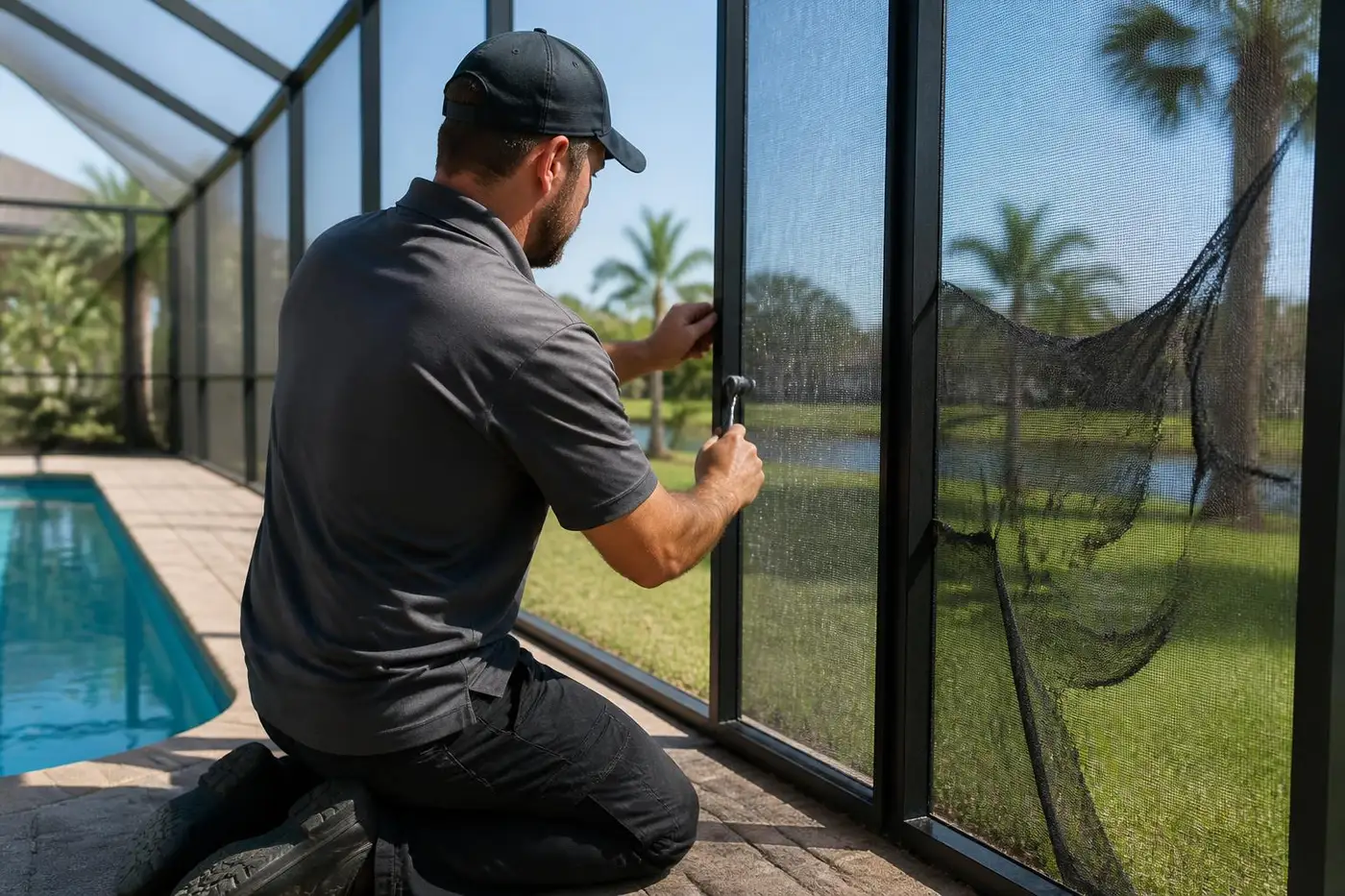
This covers straightening or replacing bent aluminum beams and posts, repairing or resetting super gutters where they've separated from the house or roofline, replacing corroded screws, tapcons, and frame connectors, rebuilding rusted or rotted kickplates at the base, and correcting door frames that have racked out of square so doors latch properly again. We treat the frame as a structural system - a fix in one spot needs to hold up under the same wind loads as the rest of the cage.
Why Pool Cages Take Damage in Jacksonville
Aluminum framing is lightweight by design, which is great for reducing load on the structure but means it can flex or bend under strong, sustained wind gusts during Northeast Florida's storm season. Salt air along the coast and Intracoastal corrodes steel fasteners and frame connectors faster than in inland areas, weakening joints over years even without a single major storm event. Ground movement and settling around the pool deck slab can also throw a cage slightly out of square over time, putting uneven stress on panel corners and doors.
Common Cage Problems We Diagnose
The most frequent issues are beams bent from falling branches or wind-driven debris, super gutters pulled loose where lag screws have corroded or backed out, doors that drag or won't latch because the frame has racked, and kickplates rusted through at the bottom where standing water and lawn irrigation keep the metal wet.
Bent or bowed beams
Usually from falling limbs or direct wind impact during a storm, visible as an obvious kink or curve in a straight frame member.
Loose or separated super gutters
Often from corroded lag screws no longer holding the gutter tight against the house or roofline.
Racked door frames
Frame settling or storm stress that throws door corners out of square, causing binding or gaps.
Corroded kickplates
Base panels that stay wet from irrigation or pooling water rust through faster than the rest of the frame.
Repair vs. Replacing the Cage
A cage with isolated bent beams or a handful of corroded fasteners is almost always repairable - we replace or straighten the affected sections using matching extrusion and hardware. We start recommending a full cage replacement when corrosion has spread across multiple structural connections, when a major storm has racked the frame significantly out of square across several sections, or when the cage was built to older wind load standards and a homeowner wants it brought up to current expectations as part of a larger project.
Materials Used in Cage Repair
We match existing aluminum extrusion profiles as closely as possible so a repaired section blends with the rest of the cage rather than standing out. Fasteners are stainless steel or coated to resist the corrosion that plain steel screws can't handle in Florida's humidity and salt air. Anchoring into the slab uses appropriately rated tapcons or expansion anchors depending on the original construction and current condition of the concrete.
Our Repair Process
We inspect the full cage first, since a bent beam in one area often points to stress that's affected neighboring sections too. Bent or damaged framing is removed and replaced with matching extrusion, super gutters are reset and re-anchored, kickplates are rebuilt where corroded, and door frames are adjusted or rebuilt so doors close and latch cleanly. We check every door and panel connection before calling the job finished, since a cage that looks fine from a distance can still have a door that doesn't seat right.
Weather and Storm Considerations
Wind load is the biggest factor in cage durability here - the same summer storms that roll through Jacksonville most afternoons in the wet season put repeated stress on frame joints. After any named storm or significant wind event, it's worth having the cage checked even if damage isn't obvious, since bent connectors or loosened anchors don't always show until the next storm. Salt air near the beaches and the Intracoastal also means fastener corrosion should be checked more frequently than on inland properties.
Planning for Cost
Cage repair costs depend heavily on how much structural work is involved - a single bent beam and a loose gutter section is a small job, while multiple corroded connections and racked doors across the structure is more extensive. We provide a free, in-person estimate so you can see exactly what's needed and what it will cost before any work begins.
Service Guide
A structural look at pool cage condition
A pool cage is a larger structural system than a standard lanai screen, with taller support posts, ridge beams, and often a domed or gable roofline that spans the whole pool area. Assessing a pool cage starts with the structural frame — checking support posts for corrosion at the base where they meet the deck, inspecting ridge and roof beam connections for looseness, and looking for any visible bowing along long unsupported spans that could indicate stress from wind loading over time.
Only after the structural frame is confirmed sound does the inspection move to the screen panels themselves, since a full rescreen against a compromised frame is a wasted investment. This is a meaningful difference from smaller lanai repairs, where the frame is rarely load-bearing in the same structural sense.
Post base corrosion
Support post bases near the deck are checked for corrosion or pitting since they carry structural load for the whole cage.
Roof beam connections
Ridge and roof beam joints are inspected for looseness, which can develop gradually from repeated wind flex.
Long-span bowing
Extended unsupported spans are checked for visible bowing, an early sign of accumulated structural stress.
Matching mesh to a full rescreen versus a partial repair
When a pool cage is being fully rescreened rather than spot-repaired, mesh selection becomes a whole-structure decision instead of a panel-by-panel one. Choosing one consistent mesh grade across the entire cage — whether standard fiberglass, pet-resistant, no-see-um, or solar screening on specific exposures — gives a uniform appearance and predictable wear pattern across the structure, which is harder to achieve when mixing mesh types added at different times.
For a cage that gets significant afternoon sun on one side, it's common to pair solar or shade screening on that exposure with standard mesh on shaded sides, which is easier to plan cleanly during a full rescreen than to retrofit into an existing patchwork of panel ages and mesh types.
Frame extrusions, spline systems, and fastener grade across a large structure
Because a pool cage covers more square footage and more linear feet of spline groove than a typical lanai, spline sizing consistency across the whole structure matters for a clean, even rescreen. Mismatched spline diameters from panel to panel — often the result of prior partial repairs done at different times — can leave some sections looser than others even with new mesh installed.
Fastener grade also deserves attention on a structure this size, since a pool cage has far more connection points between posts, beams, and panel framing than a small screened porch. Corroded or mismatched fasteners at structural connections get replaced with appropriate hardware during a rescreen, not just at the mesh-retaining points.
How a full rescreen project is sequenced on-site
A full pool cage rescreen is sequenced section by section rather than all at once, typically starting with the roof panels since they're most exposed and often the reason a full rescreen was needed in the first place, then moving to wall panels. Old mesh is stripped and disposed of, spline grooves are cleaned along their full length, and new mesh is measured, cut with margin, stretched, and spline-rolled into each panel before trimming.
Site prep for a project this size means clearing the entire pool deck perimeter, not just one section — furniture, plants, grills, and any deck equipment need a clear path around the whole cage. Because roof panels are involved, access equipment may need staging space nearby, so confirming gate widths and yard access ahead of time helps the project move without delays.
What drives cost on a full pool cage project
A full rescreen involves more variables than a single-panel repair: total panel count across roof and walls, mesh grade chosen for each exposure, how much structural fastener replacement is needed at post and beam connections, and how accessible the roof panels are given the cage's height and pitch. A single-story cage with a shallow roof pitch is more straightforward to rescreen than a tall, steeply pitched cage or one with limited yard access for equipment.
Because a full rescreen is a larger-scope project than a spot repair, getting an accurate planning range depends on sharing total approximate square footage, roof height, and whether structural issues like post corrosion or beam looseness have already been noticed.
Longevity expectations and ongoing upkeep after a rescreen
A freshly rescreened pool cage benefits from the same maintenance habits as any enclosure — periodic rinsing, prompt attention to any branch or debris contact, and checking for pooled water on the roof after storms — but the larger structure also warrants an annual look at post bases and beam connections for early corrosion or loosening, since these are the points that determine the cage's structural life well beyond the mesh's own lifespan.
Because mesh across a full rescreen was installed at the same time, wear tends to progress more evenly across the whole structure afterward, which actually makes future maintenance easier to plan since panels are less likely to need attention on a scattered, unpredictable schedule.
Why full rescreening often outlasts repeated partial repairs on a cage
On a structure the size of a pool cage, repeated partial repairs over the years tend to create a patchwork of mesh ages, spline sizes, and fastener conditions that becomes harder to manage than starting with a coordinated full rescreen. Once several sections have needed individual attention within a short span, that's usually a sign the whole structure has reached a similar age and condition, making a full rescreen the more efficient path rather than continuing to chase each new tear separately.
This is especially relevant heading into storm season for a structure with this much exposed roof area — a pool cage with mixed-age panels is more likely to have at least one weak section that fails under wind load, and evaluating the whole roof for a coordinated rescreen ahead of storm season is a more thorough approach than reacting to storm damage panel by panel afterward.
Keep Reading
Related services to compare
Fix it first: Pool Cage Screen Repair
Targeted fixes for torn screen, damaged panels, doors, frames, hardware, and storm damage.
Pool Cage Frame Repair in Jacksonville
Targeted fixes for torn screen, damaged panels, doors, frames, hardware, and storm damage.
Rescreen route: Pool Cage Rescreening
Fresh mesh across a panel, a wall, or an entire pool cage, with the screen type matched to how you use the space.
Build new: Pool Cage Installation
New pool cages, pool enclosures, lanais, screened patios, screen rooms, and custom aluminum structures.
Pool Cage Replacement explained
Full replacements and rebuilds when an aging or storm-damaged enclosure is past practical repair.
Repair option: Pool Screen Repair
Targeted fixes for torn screen, damaged panels, doors, frames, hardware, and storm damage.
Local Coverage
Pool Cage Repair across the Jacksonville area
Pool Cage Repair in St. Johns
Pool Cage Repair in Fruit Cove
Pool Cage Repair in Julington Creek
Pool Cage Repair in Mandarin
Pool Cage Repair in Ponte Vedra Beach
Pool Cage Repair in Nocatee
Pool Cage Repair in Jacksonville Beach
Pool Cage Repair in Orange Park
Pool Cage Repair in St. Augustine
Pool Cage Repair in Atlantic Beach
Pool Cage Repair in Neptune Beach
Pool Cage Repair in World Golf Village
Pool Cage Repair in Green Cove Springs
Pool Cage Repair in Middleburg
Pool Cage Repair in Fleming Island
Pool Cage Repair in Rivertown
FAQ
Pool Cage Repair questions
Can a bent pool cage beam be straightened, or does it need replacing?+
It depends on the severity of the bend and the extrusion type. Minor bends can sometimes be straightened; more significant damage usually calls for replacing that section.
My pool cage door won't latch anymore - is that a cage issue?+
Often yes. Doors that drag or won't latch usually mean the surrounding frame has racked slightly out of square, which is a structural fix rather than a door hardware issue.
Do you repair super gutters separately from the rest of the cage?+
We can, though we typically check the whole cage while we're there since gutter separation is sometimes connected to other frame stress.
How can I tell if my cage has storm damage that isn't obvious?+
Look for doors that operate differently than before, small gaps at panel corners, or gutters that seem to have shifted position - these can indicate frame movement even without a visibly bent beam.
Will cage repairs match my existing frame color and profile?+
We use matching aluminum extrusion profiles where available so repaired sections blend with the rest of your cage.
Do you also repair the screen while working on the cage frame?+
Yes, if screen panels near the repaired frame sections need attention, we can address them at the same time.
How often should an older pool cage be inspected?+
We'd suggest a look after any significant storm and a general check every couple of years, especially for cages near the coast dealing with more salt exposure.
Call (904) 853-3510 for a free estimate on your pool cage repair.
Request an estimate